
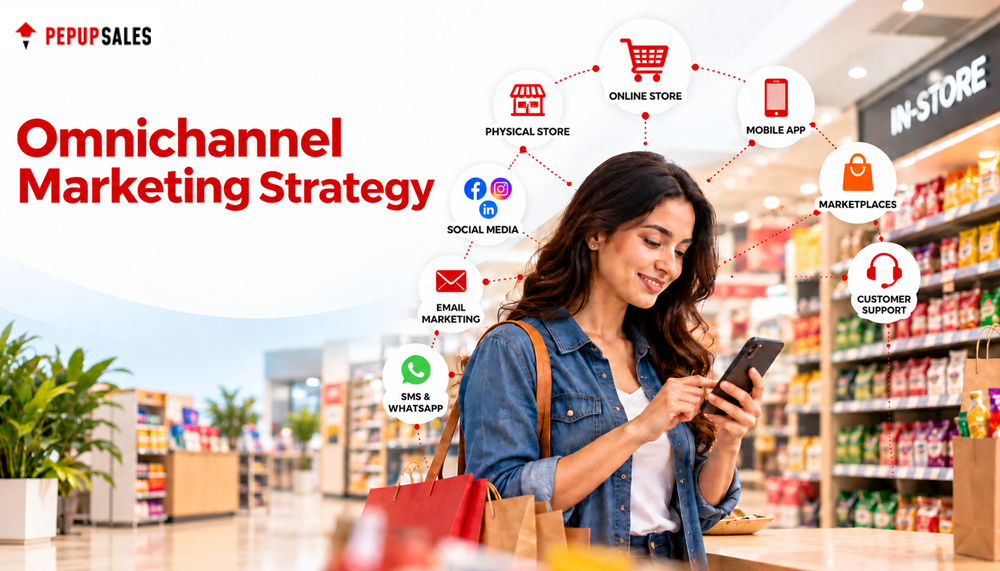
Imagine a shopper sees your product on Instagram. She checks reviews on your website. She gets a WhatsApp offer, then buys from a kirana store near her home. Which channel earned that sale?
Technically, all of them. That is why every retail and FMCG brand now needs an omnichannel marketing strategy. Earlier, shelf space used to decide who won. Today, availability, consistency, and relevance decide it. Customers move between apps, stores, and chats without thinking about “channels.” Your brand has to keep up.
This guide explains what omnichannel marketing is, how it differs from multichannel, and why it matters. It also covers the tools you need and a practical plan to start.
Quick definition: Omnichannel marketing is a strategy that connects every physical and digital touchpoint into one consistent customer experience, powered by shared data.
What Is Omnichannel Marketing?
Omnichannel marketing treats the customer as one person, not as separate records in separate systems. Your website, app, store, sales rep, and social pages all draw on the same customer profile, price list, and inventory view.
Consider a simple example. A customer adds a snack pack to her app cart and leaves. Later, she gets an SMS with a coupon. She redeems it at a retailer, and the purchase updates her profile. Every step connects.
Three ideas sit at the core:
- One customer view. Every interaction feeds a single profile.
- One consistent offer. Price, promotion, and stock match everywhere.
- One continuous journey. The customer picks up where they left off, on any channel.
Omnichannel vs Multichannel: What’s the Difference?
People often use these terms as if they mean the same thing. They don’t.
Multichannel marketing means a brand uses several channels to reach customers. However, those channels may operate independently.
Omnichannel marketing connects those channels through shared data, technology, processes, and customer insights.
| Factor | Multichannel | Omnichannel |
| Channel setup | Each channel runs alone | Channels share data and goals |
| Customer view | Fragmented | Unified |
| Pricing and stock | Often inconsistent | Synced in real time |
| Focus | The channel | The customer |
| Typical result | Repeated or conflicting messages | Relevant, timely messages |
A multichannel brand is present everywhere. An omnichannel brand is connected everywhere. That gap decides whether customers feel recognized or ignored.
How Omnichannel Marketing Evolved
Retail started with a single channel: the store. Catalogues and call centres followed, then websites in the late 1990s. Brands added each channel as a separate project with its own team and budget.
When smartphones came on the market, that model failed. People started to shop on one device, compare on another, and then purchase on yet another. Brands had tools to respond, in the form of cloud-based CRMs, point-of-sale integration and mobile commerce. The flow of sales and marketing finally began.
The movement continues to the present day with the rise of quick commerce, WhatsApp ordering, and retailer apps. Omnichannel is no longer a “nice to have,” but rather a “must have.”
Why Is Omnichannel Marketing Important for Retail Brands?
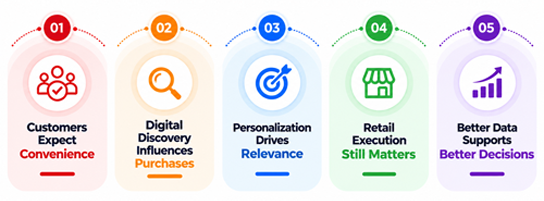
Customers increasingly move between digital and physical touchpoints.
Salesforce’s latest Connected Shoppers research reports that 53% of shoppers discover products through social platforms. It also found that 88% of retailers say unified commerce will significantly impact their goals.
For brands, this changes the role of marketing. Marketing can no longer stop at generating awareness. It must connect awareness with availability, execution, conversion, and retention.
1. Customers Expect Convenience
Consumers want to find products in a matter of seconds, compare them, and purchase from the channel they like. Having a strong omnichannel integration means there’s no reason to add any friction to this. The one thing that is crucial is that customers need to be able to move onto the next step, either online or at the store.
This means synchronizing product discovery, availability, ordering, delivery, and follow-up interaction for the retail brands. The fewer things you have to fix the customer is going to be more inclined to make a purchase.
2. Digital Discovery Influences Physical Purchases
A user can conduct research of a product on the internet but purchase it from a retail outlet.
After that, there is an intrinsic link between online and offline performance. Although a digital campaign can create demand, it is crucial that the product is in place, available, and ready to sell at the right store at the right time when the customer is ready to buy.
Brands need to have visibility in both digital engagement and execution in the physical market. Linking these signals can provide businesses with insights into the point of creation of demand and if retail operations are ready to meet it.
3. Personalization Drives Relevance
Customer data is linked to inform brands about the purchases made, what they like, how they like, how they interact with the brand and which channels they use.
That information can be utilized to create more beneficial offers and recommendations. Brands can communicate different messages to different customers based on their previous viewing, buying, or customer interaction with the brand.
Personalisation can also be applied to retailers and outlets for CPG and retail brands. Outlet-level purchase patterns are very helpful for the sales team to recommend products, inventory and promotions based on the individual products purchased.
4. Retail Execution Still Matters
Digital engagement is no replacement for a product that’s not on hand.
When consumers browse online, but can’t locate the product in the store, the trip ends. This also happens if the product is in stock but not on show, is sold at an incorrect price or is not within the correct price range of products. This is why it’s important for omnichannel strategy to extend beyond marketing technology to also permeate inventory, distribution, field sales and retail execution.
Improved visibility of the outlets allows the brands to see where outlets are not available, optimize their merchandising, and ensure the brands’ market execution is aligned with the demand from the digital channel.
5. Better Data Supports Better Decisions
Decision-makers can detect patterns quicker when customer, sales and inventory data are combined with channel data. They can find out what is selling, where, which channels are effective, and which are missing opportunities to be taken advantage of. Gives teams the overall customer journey and its various touchpoints.
As for sales and marketing executives, this vast amount of connected data can also help them identify underperforming channels, high-potential markets and re-allocate resources.
Key Components of an Omnichannel Marketing Strategy
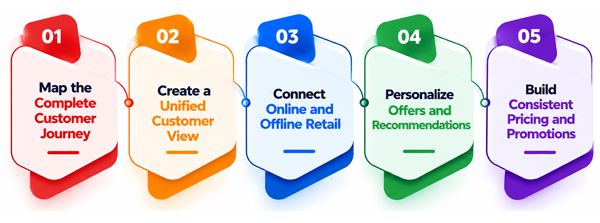
A successful omnichannel strategy does not start with technology. It starts with the customer journey.
1. Map the Complete Customer Journey
First, identify every major customer interaction. For a consumer brand, the journey may look like:
Discover → Research → Compare → Locate → Purchase → Use → Engage → Repurchase
Now identify where each interaction happens.
For example:
- Discovery: Instagram
- Research: Website
- Availability: Retailer app
- Purchase: Physical store
- Engagement: WhatsApp
- Loyalty: Mobile app
This exercise shows channel interfaces. It also enables teams to gain insight into the flow of customers through the channels and where they might be lost along the way.
In a retail brand, it needs to involve both the touchpoints that customers interact with and the processes that support these activities. Marketing creates demand, but sales, distribution, retail and inventory teams need to play a supporting role.
2. Create a Unified Customer View
Customer data is commonly distributed among systems such as CRM, e-commerce, loyalty, POS and marketing applications. These data points are consolidated in an omnichannel model. Rather than viewing each interaction as a one-off event, brands can gain a better understanding of customer interactions.
This way, teams can grasp customers as a whole, not just on an individual basis. It can also enable improved segmentation, customer targeting, product suggestions, and retention efforts.
For distributed brands, this single view must be linked to customer demand and sales/distribution information, wherever possible.
3. Connect Online and Offline Retail
It is here that many strategies fail. A brand can execute great marketing campaigns digitally but might not be aware of the retail executions. This leaves a gap between demand generation and product availability.
Brands should connect:
- Digital campaigns
- Retailer availability
- Sales orders
- Distributor inventory
- Store visits
- Product assortment
- Promotions
- In-store execution
In the case of distributed retail networks, Sales Force Automation Software and Distributor Management Software can be a crucial layer in operations.
This can help businesses understand what customers want and what’s going on in the market. Sales teams can be notified of availability issues, record orders, track executions and provide market level feedback.
4. Personalize Offers and Recommendations
Personalization should be much more than just including the customer’s name in an e-mail. Purchase history, product preferences, location, channel behavior, and frequency of purchase are all data that can be utilized to provide a relevant experience to brands.
For instance, if one retailer buys a specific product category regularly, he/she might get a replenishment recommendation in the right direction at the right time. After purchase, a customer can also be given free recommendations for products.
This could be used in a similar way throughout the field sales. Outlet-level data can help sales reps select the right SKUs, offer product suggestions and enhance order quality. This means that personalization is more tangible and practical, as it aligns with real customer data and actual sales activity.
5. Build Consistent Pricing and Promotions
Nothing damages trust faster than inconsistent offers. A customer may see one price online and another at a physical store. Retailers may also face confusion when promotional schemes differ across channels without clear rules.
Brands should establish clear rules for:
- Pricing
- Discounts
- Promotions
- Loyalty rewards
- Schemes
- Product bundles
- Channel-specific offers
Some differences may be necessary across channels. The important part is making them deliberate and manageable. Connected systems can also help teams monitor whether promotions are being executed correctly across stores and sales channels.
How PepUpSales Supports Omnichannel Sales and Retail Execution
For distributed brands, omnichannel success extends beyond digital marketing. The physical market still matters. PepUpSales helps businesses connect field sales, retail execution, distribution, secondary sales, and analytics within one unified platform.
Field sales teams can execute outbound visits, orders, beats, routes, merchandising and market activities with a connected workflow. This provides teams with a clearer picture of everything that’s going on across the retail network.
Sales managers can track sales performance in the field, market penetration and outlet productivity, product movement, and retail execution. They can also use these insights to uncover areas of opportunity that could impact customers’ availability.
Distribution teams can gain greater visibility into orders, inventory, schemes, invoices and secondary sales. This better links distributor activities to market demand.
AI-powered capabilities can further support route planning, product recommendations, forecasting, and sales decisions. These learnings can then help teams prioritize opportunities and be more responsive when executing on the field.
Most importantly, PepUpSales connects demand signals with market execution.
A campaign may create demand. A retailer may need stock. A sales representative may need to place the order. A distributor may need to fulfill it. When these activities work together, the customer experience becomes more consistent across digital and physical channels. That connection is where omnichannel strategy becomes operational.
A 90-Day Omnichannel Roadmap
Aberdeen Group research, widely cited by industry analysts, reports that brands with strong omnichannel engagement retain a far higher share of customers than those with weak engagement. You do not need a full transformation on day one. Start with this sequence:
Days 1–30: Audit.
- Map every customer and trade touchpoint.
- List where data lives and who owns it.
- Identify price, stock, and offer mismatches.
Days 31–60: Connect.
- Integrate your core systems: CRM, POS, inventory, SFA, and DMS.
- Standardize pricing and scheme rules.
- Pick one or two high-impact use cases, such as WhatsApp ordering or unified loyalty.
Days 61–90: Activate and measure.
- Launch your pilot in one region or category.
- Set baseline KPIs.
- Review results weekly and adjust.
Then scale what works.

Conclusion
Omnichannel marketing is not about being present on every platform. It is about making every relevant interaction part of the same customer journey.
For modern retail and CPG brands, that means connecting digital engagement with physical availability. It means connecting marketing with sales. It means connecting retailers, distributors, field teams, inventory, and customer data. The strongest omnichannel strategies do not stop at the screen.
They reach the shelf. With the right technology and operating model, brands can turn fragmented interactions into one connected commercial engine.
Ready to connect sales, distribution, retail execution, and customer insights? Explore how PepUpSales can help build a more connected omnichannel sales ecosystem.
Frequently Asked Questions
1. What is an omnichannel marketing strategy?
Omnichannel marketing strategy is a plan that synchronizes all online and offline touchpoints to deliver a seamless customer experience. It is based on common customer data, synced pricing and common visibility of inventory.
2. What is the difference between omnichannel and multichannel marketing?
Multichannel marketing is a strategy that leverages numerous individual channels. Omnichannel marketing brings them together, and maintains a seamless customer journey by sharing data.
3. Why is omnichannel marketing important for FMCG brands?
Brands are interacted with by FMCG customers through retailers and stores, via e-commerce, social media and other channels. Omnichannel marketing bridges the gap between demand generation and the product being available at a retail level and the customer’s engagement with it.
4. Which KPIs measure omnichannel success?
Measure retention, customer lifetime value, cross channel conversion, fill rate, retailer reorder rate, cost to serve and cross channel attribution.
5. How can small and mid-size brands start with omnichannel?
Begin with a touchpoint audit, then unify your customer and inventory data. Launch one pilot, such as WhatsApp ordering or an integrated loyalty program, and measure results before scaling.


