

Your products are selling well. Orders keep coming in. On paper, business looks great. But behind the scenes, one warehouse is overflowing while another region runs dry. Distributors keep calling about pending payments, and you’re never quite sure which trade scheme is actually moving the needle.
As FMCG, pharma or consumer goods brands scale, this is one of the problems that is very common. Your distribution network is small enough that spreadsheets, phone calls and emails are all fine. However, when it reaches the stage where it spreads into regions and partners, the same techniques become a liability.
This is where the distribution management system comes in. So what does a DMS do? What is its relevance to growing brands and how can the right system instill order in your entire distribution network? Let’s explore that in this blog.
What Is a Distribution Management System?
A distribution management system, or DMS, is a software solution that handles the entire distribution process of goods from your warehouse to the end retail shelf. It brings together all brands, distributors, stockists and retailers on a common platform.
Consider a DMS as your supply chain control tower. All orders, all stock movements and all payments go through it. There is no language barrier between teams any longer.
A distribution management system in India simply means that all of your phone calls, and all of your Excel spreadsheets, are consolidated in a single digital system. The same data is displayed in real-time to everyone. This translates into fewer mistakes, quicker decision making, and much less back and forth between your office and your distributors.
An ideal DMS software usually includes primary order processing, secondary order processing, real-time stock visibility, trade scheme management, claims and returns processing, and sales reports. These functions work hand in hand to make up the backbone of a brand’s road-to-market approach.
Why Is a Distribution Management System Important?
Here’s the thing, distribution isn’t just a background operation. It’s the difference between a product that is selling and a product that is just in a warehouse. When you don’t know what’s going on with your stock, you are making guesses rather than making decisions. At scale, guessing gets pricey quickly.
A DMS is important because it makes distribution a control room. You no longer get complaints from irate retailers about stockouts, you begin to see them arrive days in advance. You’re no longer left to speculate if a distributor has surplus stock, but you’re now always aware of what’s flowing and what isn’t.
It also has relevance because your distributors are your initial customers. If they don’t believe your numbers, on schemes, on payments, on claims they slow down, so does your business. A good distribution management system is conveying that trust, it’s not promising it.
As your network grows from ten distributors to a hundred, from one state to five, the cracks that spreadsheets and phone calls hide today become impossible to ignore tomorrow. A DMS is the tool to help you scale distribution without losing control.
Key Features of a Distribution Management Software
An effective distribution management software isn’t just about digitizing existing processes – it’s about reimagining how distribution should work in the digital age. Here are the essential features that separate good DMS solutions from great ones:
1. Intelligent Digital Order Management
Gone are the days when distributors had to call sales reps to place orders. A modern DMS allows distributors to place primary orders directly through web or mobile interfaces. But here’s where it gets interesting – AI-powered systems can suggest optimal order quantities based on historical data, seasonal patterns, and current stock levels. This means distributors are nudged to order smart, not just order more.
2. Real-time Stock Visibility Across the Network
Just imagine what it would be like to have a bird-view of your whole distribution network at any one time. An excellent DMS gives real-time view of stock in all the distributor outlets ensuring that the brands and distributors do not run out of stock or end up with excess stocks. Smart alarms provide information to the stakeholders before the problems happen so that they can act on time before they can occur.
3. Dynamic Scheme & Incentive Tracking
This is the area where DMS solutions really perform very well. The promotions and incentives used to trade are directly presented at the ordering point, so that distributors know exactly what they are earning. Tracking of the progress in real-time helps distributors know their progress towards the target and motivates them.
4. Comprehensive Claims & Returns Management
All distribution networks have to deal with claims of damaged goods, expired stock, scheme redemptions. This is simplified by the use of a centralized claims management portal whereby manual paperwork is minimized and resolutions are quickened.
5. Transparent Payment & Credit Tracking
Real time clear statements of accounts eliminate the chances of disputes over payments even before they arise. The distributors are able to get a clear picture of what they owe, what credits are due, and when payments are expected.
6. Advanced Analytics & Reporting
Modern distribution runs on data and a smart DMS converts raw data into actionable intelligence – as a refinery converts crude to fuel. Everything is measured, analyzed, and visualized: sales performance, fill rates, the activity of distributors, the effectiveness of schemes, so as to make better decisions.
Why Your Business Needs a Distribution Management System
Let’s be brutally honest – managing distribution through spreadsheets, phone calls, and emails isn’t just outdated; it’s a business liability waiting to happen. Every day you delay implementing a proper DMS, you’re potentially losing sales, frustrating distributors, and missing opportunities to optimize your supply chain.
Here’s why traditional distribution management methods are failing modern businesses:
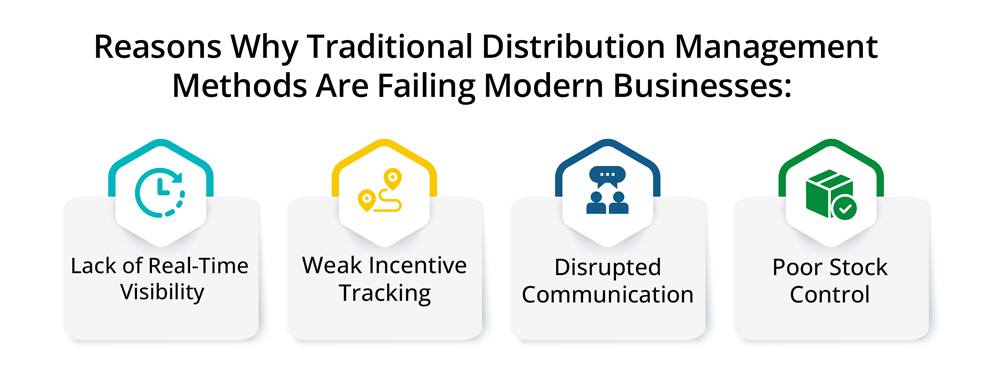
- Lack of real-time visibility: Without a DMS, you have no idea what’s happening after your products leave the warehouse.
- Disrupted communication: Traditional methods slow down collaboration between brands and distributors.
- Poor stock control: Overstocking or stockouts happen more frequently without an intelligent system.
- Weak incentive tracking: Distributors usually can’t see the entire scheme or do not see sales targets clearly.
A distributor management system closes all these gaps, enabling brands to implement their distribution strategy with precision, speed and control.
Benefits of Using a Distribution Management Solution
Implementing a powerful distribution management solution has wide-ranging benefits — not just for brands, but also for their channel partners.
For Brands:
- Smarter Inventory Management: Prevent stockouts and reduce wastage.
- Better Market Reach: Streamline supply across general trade, modern trade, and HoReCa channels.
- Increased Primary Sales: With digital nudges and visible schemes, distributors are more likely to place timely and larger orders.
- Data-Driven Decision Making: Real-time sales data helps brands adapt to market shifts quickly.
- Efficient Trade Promotions: Understand what promotions work and optimize spend.
For Distributors:
- Self-ordering Made Simple: No waiting for sales reps. Place orders anytime, anywhere.
- Scheme Visibility: Know exactly what incentives are on the table and how close they are to hitting targets.
- Transparency in Payments: Clear financial statements build trust and accountability.
- Reduced Manual Effort: Save time and effort through automation.
In short, a distribution management software transforms how businesses and distributors work together — creating a win-win ecosystem.
How to Implement a Distribution Management System
Implementing a DMS isn’t just about purchasing software – it’s about transforming your entire distribution approach. Here’s a proven roadmap for smooth implementation:
Phase 1: Define Clear Objectives
Begin by determining certain issues that you would like the DMS to address. Do you have inefficient fill rates, inventory discrepancies, low secondary sale tracking or distributor involvement problems? Clarity of goals will assist you to get the appropriate solution and gauge success.
Phase 2: Select a Scalable Flexible Solution
Choose a distribution management system that is scalable to your business and can be altered to fit other industries or processes. Seek out modular solutions that can be tailored without a lot of development effort.
Phase 3: Secure Distributor Buy-in
This is essential, your DMS must be adding value to distributors and not brands only. Such functions as self-ordering, real-time reporting, payment transparency, and scheme transparency are supposed to make the lives of distributors, rather than complicate them.
Phase 4: Ensure Seamless Integration
Your DMS ought to blend well with other established systems such as ERPs, accounting tools (such as Tally), and field sales applications. The flow of data must be smooth without the involvement of humans.
Phase 5: End to End Training & Support
Carry out thorough training sessions and provide continuous support during the transition phase. Remember that the secret to success is adoption.
Phase 6: Monitor, Measure and Optimize
Monitor the adoption level, order patterns, and sales increase after implementation using in-built analytics. The perpetual optimization will guarantee that you are getting the best of your investment.
Common Challenges and Solutions
Even the best distributor management systems can face hurdles. But these challenges are manageable when approached smartly.
| Challenge | Why It Happens | Solution |
| Manual order placement | Distributors still use calls/spreadsheets | Enable mobile/web-based ordering |
| Poor scheme visibility | Incentives not shown during ordering | Display trade promotions in real-time |
| Distributor resistance | They see DMS as brand-focused | Offer benefits like self-ordering, insights |
| Payment disputes | Lack of transparent statements | Provide clear digital account summaries |
| Stock mismanagement | No real-time tracking | Enable smart stock alerts & low-stock nudges |
| Limited access | System not mobile-friendly | Provide mobile-optimized interfaces |
These challenges can be easily overcome by selecting the right platform and making sure that it is value additive to both brand and distributor.

Conclusion
Distribution is becoming more complex every year, and brands that rely on outdated, manual methods will eventually fall behind. Having a distribution management system that performs well is no longer a luxury, but a must have for any business dealing with distributors, stockists, and retailers.
In PepUpSales we have created our distribution management system that benefits brands and distributors equally. Easy to use, mobile-friendly, scalable and already able to be integrated with your existing tools. You can use PepUpSales to structure, transparently and visibly, your whole distribution network – irrespective of your business scope, from FMCG to pharma, building materials to consumer goods – and have your supply always “on demand”, never “on the back of the neck.
Ready to see it in action? Contact PepUpSales today to schedule a free demo and see how a smarter distribution management system can benefit your business.
Frequently Asked Questions
1. What is a distribution management system?
A distribution management system is software that helps brands manage the flow of products from the warehouse to distributors, retailers, and finally the end customer. It includes order processing, stock visibility, scheme monitoring, claims and payments in a single platform. No longer is there a need for individual calls, spreadsheets or WhatsApp communication with anyone, from the brand’s head office to the smallest distributor, all working with the same up-to-the-minute information. This common visibility is what sets a DMS apart from a standard inventory tool.
2. How long does it take to implement a distribution management system?
Depending on the network size and integration requirements, most medium-sized brands can deploy a DMS to their distributor network in a matter of weeks, particularly if the DMS has ready-to-use templates and dedicated onboarding support. This will usually follow a number of steps, from initial set-up and configuration, through to a pilot rollout of the smaller distributor group, followed by a regional rollout phase. Complicated ERP integrations or a larger distributor base will likely require just a little longer runway for brands.
3. What’s the pricing for a distribution management system?
Pricing usually depends on the number of distributors, outlets, and features you need, such as order management, scheme tracking, or analytics. For most vendors the model is the per user or per distributor license one, in addition to optional modules such as the AI-based forecast or advanced reporting. It is not a universal flat fee as a network of 5 states for FMCG products has different requirements than a single region for a pharma distributor. PepUpSales has custom pricing based on size of network, so please contact us for a quote that will fit your business.
4. What is the difference between primary, secondary, and tertiary sales in a DMS?
Primary sales are sales made by the brand to the distributor, secondary sales are made from the distributor to the retailer and tertiary sales are made from the retailer to the consumer. A decent DMS will have the ability to monitor all three for full visibility. The difference is important because primary sales can be deceptive – a distributor may order a lot but not necessarily sell it out, and that would lead to an over-inflated number. By following the path of secondary and tertiary sales, a much more complete picture of what is really selling is achieved.
5. Can I get a free demo of a distribution management system (DMS)?
Yes, absolutely. You can schedule a free demo with PepUpSales. During the demo, our product experts will walk you through the platform, showcase key features, and demonstrate how the system can be tailored to your distribution network and business processes. This is a no-obligation walkthrough, and the session can include specific pain points (stockouts, claims delays, scheme confusion) so that the walkthrough is relevant to your business, rather than a generic walkthrough.


