Sales performance is shaped by two things: the quality of customer relationships and the quality of sales execution. CRM software primarily strengthens the first. Sales Force Automation strengthens the second. That distinction sounds simple, but the lines have become blurred as modern sales platforms add overlapping features.
A CRM may offer sales automation, mobile apps, dashboards, and activity tracking. An SFA platform may also store customer and outlet information. So, where does one end and the other begin? More importantly, which one does your sales organization actually need? The answer depends on how your teams sell, where they operate, and what you need to improve.
In this guide, we break down the key differences between SFA and CRM, compare their features, use cases, and business value, and explain when businesses should choose SFA, CRM, or both.
What Is Sales Force Automation (SFA)?
Sales Force Automation (SFA) is software that automates and manages repetitive sales activities. More than automating routine tasks, SFA creates an execution layer between sales strategy and what happens in the market. It gives sales teams a structured way to plan work, execute market visits, capture orders, track performance, and report results.
Traditional sales teams often depend on spreadsheets, calls, WhatsApp messages, manual reports, and disconnected applications. SFA replaces much of this manual coordination with a centralized system.
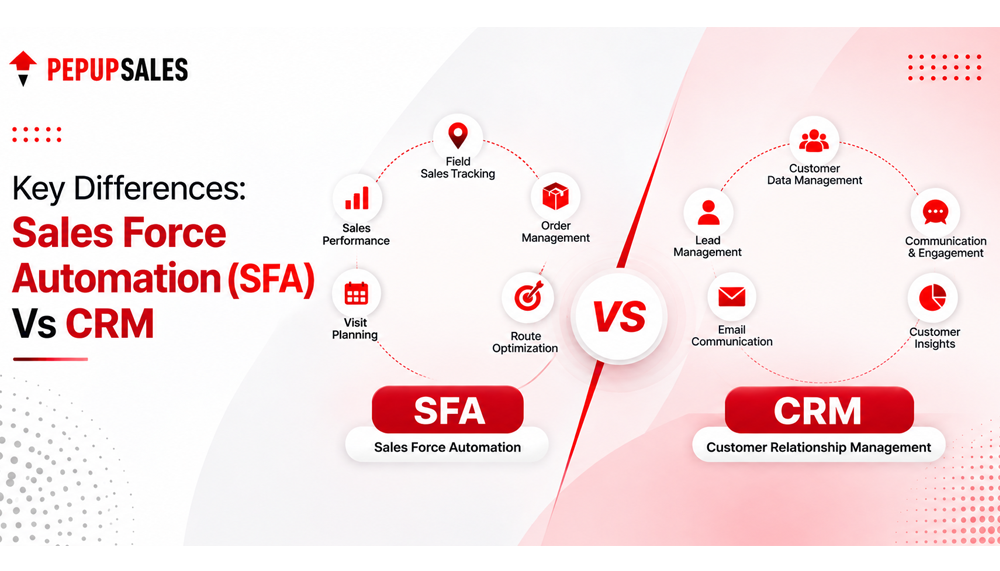
Common SFA software features include:
- Sales representative tracking
- Beat planning
- Route optimization
- Outlet management
- Visit planning
- Attendance tracking
- Order taking
- Target management
- Sales reporting
- Retail execution
- Scheme management
- Inventory visibility
- Sales analytics
- Performance dashboards
- Offline field operations
- AI-powered recommendations
The important point is that SFA is not simply about storing sales information. It helps answer a more operational question:
“What should my sales team do today, and how well are they executing it?”
That makes SFA particularly relevant to consumer brands, distribution-led businesses, pharmaceutical companies, automotive businesses, building material companies, and other organizations with distributed field teams.
What Is CRM?
Customer Relationship Management (CRM) is software designed to manage interactions with current and potential customers.
A CRM creates a central record of customer information. It can include contact details, communication history, sales opportunities, purchase information, service interactions, and other customer data.
Typical CRM software features include:
- Contact management
- Lead management
- Opportunity management
- Account management
- Email tracking
- Customer communication
- Sales pipeline management
- Customer service
- Follow-up management
- Customer segmentation
- Reporting and forecasting
CRM answers a different question:
“What do we know about this customer, and how can we improve the relationship?”
This makes CRM particularly useful for businesses where sales depend heavily on account management, relationship building, lead nurturing, and customer service.
Modern CRM platforms can span marketing, sales, commerce, and customer service, making them a central system for managing the customer lifecycle.
SFA vs CRM: What Is the Difference?
The easiest way to understand the difference is to compare their primary responsibilities.
| Factor | Sales Force Automation (SFA) | CRM |
| Core purpose | Automate and control sales execution | Manage and deepen customer relationships |
| Main users | Field reps, area managers, sales ops | Inside sales, marketing, support |
| Where it works | Outlets, markets, on the road | Desk, phone, email |
| Data captured | Visits, orders, routes, attendance, stock | Contacts, interactions, tickets, history |
| Key metrics | Strike rate, lines per call, coverage, productivity | Retention, satisfaction, lifetime value |
| Connectivity | Built for patchy networks, offline-first | Usually assumes steady internet |
| Time horizon | Today’s targets | Long-term loyalty |
| Best fit | Distribution-led, field-heavy businesses | Relationship-led, service-heavy businesses |
The table gives you the outline. The sections below explain why the differences matter on the ground.
Difference 1: What the System Is Built to Track
A CRM tracks the customer. An SFA tracks the work.
Consider a rep who visits 30 outlets a day. A CRM can maintain the retailer’s profile, interactions, opportunities, and history. SFA goes deeper into the execution layer by capturing whether the rep visited the outlet, what was available, which SKUs were sold, what order was placed, and whether the expected activity was completed.
That execution record gives managers the visibility they need to coach teams, identify gaps, and improve market performance.
Difference 2: Who Uses It Daily
CRM and SFA may serve the same sales organization, but they support different workflows.
CRM is typically used to manage customer records, opportunities, conversations, follow-ups, and account activity. SFA is designed around the daily execution of sales teams, particularly when representatives work across territories, outlets, dealers, or distributors.
For field teams, usability becomes critical. Sales representatives need to complete visits, capture orders, update activities, and access relevant information quickly while working in the market. SFA platforms are therefore designed around shorter workflows and field-specific activities.
Difference 3: The Kind of Data Each One Creates
CRM data is about identity and history. It is a description of a customer. The data in SFA is related to activity and outcome. It describes execution.
The difference, particularly in general trade, is most significant. India has more than 1.4 crores of kirana stores and they make about 75-80% of the sales in FMCG. Brands know what to sell to distributors, but don’t have information on what a distributor sells to a store. That’s where a CRM can’t fill in the gap. Field level SFA data can be integrated with distributor data.
Difference 4: How Success Is Measured
CRM metrics often focus on relationship and pipeline outcomes, such as retention, engagement, opportunity progression, and customer value.
SFA metrics focus more directly on field execution, including outlet coverage, productive calls, strike rate, lines per call, target achievement, and sales productivity.
Because SFA metrics are closely tied to daily and weekly activity, sales managers can identify execution gaps earlier and take corrective action.
Difference 5: Time and Productivity
Selling time is a scarce resource. Salesforce’s State of Sales research keeps finding that reps spend well under half of their week selling, with figures ranging from about 28% to 40% across reports. All other activities are assigned to admin, internal meetings, data entry and search for information.
The SFA tackles the issue head on. It eliminates manual reporting, auto-plans routes and auto-fills order ideas. CRM will help you know the customer better. It doesn’t come back hours to the rep.
SFA vs CRM: Which One Should You Choose?
The answer depends on the problem you are trying to solve.
Choose CRM if you need to:
- Centralize customer information
- Manage leads and opportunities
- Improve follow-ups
- Track customer interactions
- Manage account relationships
- Improve customer service
- Build a structured sales pipeline
- Improve retention and engagement
Choose SFA if you need to:
- Manage field sales teams
- Improve outlet coverage
- Plan beats and routes
- Track sales representatives
- Capture field orders
- Improve sales productivity
- Monitor market execution
- Manage retail visits
- Track targets and performance
- Improve visibility across territories
Consider both if you need to:
- Manage customer relationships and field execution
- Connect office and field sales
- Integrate customer data with market activity
- Build a unified sales technology ecosystem
- Scale a complex distribution network
The important thing is not to buy software because it has the right label.
Buy based on the work your teams actually perform.
Why Teams Choose PepUpSales
PepUpSales is a Sales Force Automation and Distribution Management System platform for enterprise FMCG, CPG, Retail, Automotive, Pharma, Building materials, and Distribution businesses. Teams across India, Africa, the Middle East and Southeast Asia use it to run daily field operations.
With PepUpSales, businesses can:
- Plan beats and monitor visit compliance in real time
- Capture orders and apply schemes on the spot
- Track targets, attendance and team performance from one dashboard
- Connect field data with distributor and secondary sales
- Fit the platform alongside the CRM and ERP they already use
You do not have to discard your CRM. PepUpSales handles the execution layer, and your CRM keeps handling the relationship layer. PepUpSales can also work alongside existing CRM and ERP environments, allowing businesses to connect customer information, field activity, distribution data, and business reporting without rebuilding their entire technology stack.

Final words
There is no universal winner in the SFA vs CRM debate. The question is not whether SFA is better than CRM. The real question is where your sales organization needs greater control.
If the priority is customer relationships, opportunities, account management, and engagement, CRM may be the stronger foundation. If the priority is field execution, outlet coverage, order capture, sales productivity, and market visibility, SFA becomes critical.
For complex sales organizations, the strongest approach may be to connect both. CRM can manage the relationship layer while SFA manages execution in the market.
The right sales technology should reflect how your teams actually sell—not simply what features a software category promises.
PepUpSales brings sales execution, distribution, retail visibility, and AI-powered intelligence together to help businesses turn sales strategy into measurable market execution. Schedule a free demo to know more.
FAQs
1. What is the difference between SFA and CRM?
SFA focuses on automating and managing sales execution, while CRM focuses on customer relationships, accounts, opportunities, interactions, and the customer lifecycle.
2. Is SFA part of CRM?
It can be. Some CRM platforms include sales-force automation capabilities, while others focus primarily on customer and account management. Dedicated SFA platforms typically provide deeper functionality for field sales execution, including beat planning, route optimization, outlet visits, order capture, retail execution, and field productivity.
3. What are the main features of SFA software?
Some of the most common features include sales force tracking, beat planning, route optimization, outlet management, visit management, order taking, target management, retail execution, analytics, scheme management, and AI-driven recommendations.
4. What are the key features of CRM software?
CRM typically has the following features: contact management, lead management, opportunity management, account management, communication tracking, customer service, sales pipeline management, segmentation, reporting, and forecasting.
5. Do I need both SFA and CRM?
You may. For organizations that require powerful CRM and field execution capabilities, a CRM integration with SFA can offer a higher level of visibility throughout the sales cycle.
6. What should I look for when buying SFA software?
Assess offline functionality, sales tracking, order capture, outlet management, analytics, integrations, sales scalability, AI features, and ease of adoption. The feature-richest SFA software isn’t necessarily the best. It’s the one your sales team can really use every day.


