
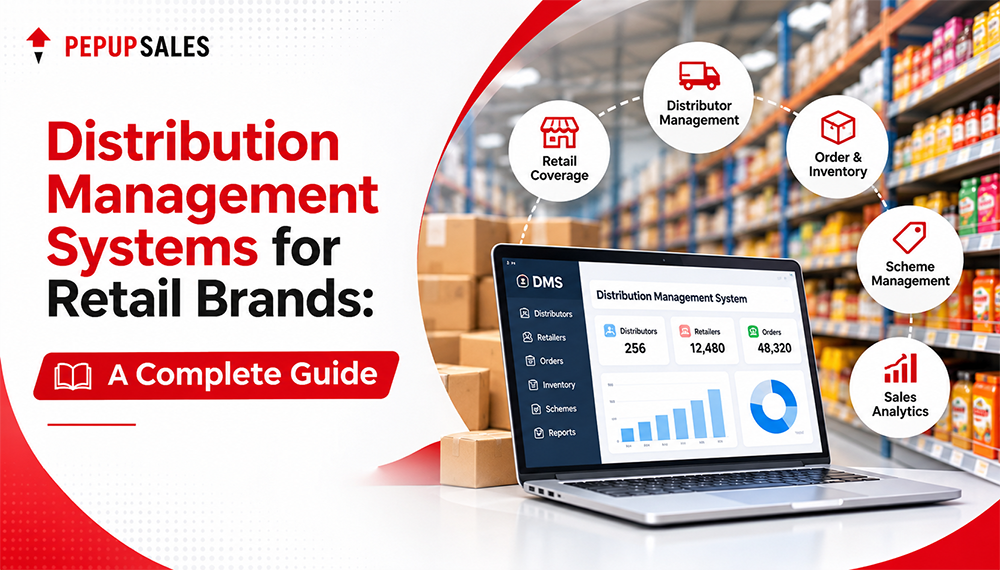
Retail distribution involves much more than moving products from warehouses to stores. Brands must coordinate distributors, manage inventory, process orders, execute trade schemes and maintain product availability across multiple markets. As distribution networks expand, these activities become harder to manage through disconnected software and manual reporting.
A Distribution Management System (DMS) helps retail brands bring these processes together. It connects distributors, sales teams and retailers through a unified platform. More importantly, it gives businesses visibility into what happens after products leave their warehouses.
According to Manhattan Associates’ 2024 Supply Chain Confidence Survey, 38.8% of retailers identified having enough inventory as their biggest concern. The finding highlights an ongoing challenge: maintaining the right inventory while responding to changing demand.
This guide explains how distribution management systems work, which features matter, how they benefit retail brands and what businesses should evaluate before choosing one.
What Is a Distribution Management System?
A Distribution Management System (DMS) is software that helps businesses plan, execute and monitor distribution activities across their sales network. It connects manufacturers or brands with distributors, dealers, wholesalers and retailers. The platform records transactions and provides visibility into product movement throughout the distribution network.
Consider a retail brand operating through 150 distributors across five states. Its head office may know how much stock it has dispatched. However, it may not know how much stock each distributor holds or sells. It may also struggle to identify which products are moving slowly or which markets require replenishment.
A DMS addresses these information gaps.
It creates a structured flow of information across the distribution network:
Brand → Distributor → Wholesaler (where applicable) → Retailer → Consumer
The system primarily captures transactions between the brand, distributors and retailers. Additional retailer sell-out or point-of-sale integrations can extend visibility towards consumer purchases.
A DMS therefore goes beyond distributor billing. It helps businesses understand how products move across markets and where distribution performance needs attention.
Distributor Management System vs Distribution Management System
These terms are often used interchangeably in the software market. A distributor management system commonly refers to the technology brands use to manage distributor transactions, stock and accounts. A distribution management system can describe a broader operational scope covering the complete distribution network.
However, the naming convention is not consistent across vendors.
Businesses should evaluate the actual capabilities rather than rely on product terminology. The critical question is whether the platform provides visibility into both distributor operations and downstream sales. To get a more detailed view of their differences, read our blog of Distributor Management System vs Distribution Management System
Understanding Different Distribution Models in Retail
Not every retail business distributes products in the same way. The operating model depends on product categories, market coverage, order volumes and channel relationships. A DMS should support the distribution structure a business actually follows.
1. Direct Distribution Model
In this model, manufacturers sell products directly to retailers without using independent distributors. The brand manages ordering, inventory allocation, invoicing and deliveries. This model offers greater control over customer relationships and distribution activities.
It works well for businesses with established delivery infrastructure and concentrated markets.
2. Indirect Distribution Model
Here, products move through distributors, wholesalers or dealers before reaching retailers. The brand depends on channel partners for market coverage and product availability.
A DMS helps coordinate these partners, monitor secondary sales and maintain visibility into distributor inventory.
3. Multi-Tier Distribution Model
Some businesses use multiple intermediary levels. For example:
Manufacturer → Super Stockist → Distributor → Wholesaler → Retailer
Each layer handles a specific distribution responsibility. However, every additional layer can make information sharing more complicated. A connected DMS helps businesses maintain consistent reporting and transaction visibility across supported channel levels.
4. Hybrid Distribution Model
Many retail brands operate through multiple distribution channels simultaneously. They may serve general trade through distributors, modern trade through centralized accounts and selected customers through direct distribution.
A hybrid model provides flexibility. However, businesses must manage different pricing structures, ordering processes, credit terms and service expectations. The right distribution management software should accommodate these differences without creating separate reporting silos.
5. Direct Store Delivery (DSD)
Direct Store Delivery is when brands or their distribution partners ship directly to retail sites.
This is a regular model in those categories where delivery frequency, freshness of inventory and the speed of replenishment are important factors. The delivery tracking and transaction reconciliation, order processing, dispatch visibility are some of the capabilities a DMS can provide. The integration of Van sales can further link vehicle inventory and ground sales.
The software selection process should be based on the distribution model. A legacy-based distributor billing system doesn’t necessarily meet all the operational needs.
How Does Distribution Management Software Work?
A Distribution management software connects activities that traditionally operate across separate departments. Businesses can leverage this lifecycle to determine the optimal points for automation and visibility.
Step 1: Demand and Supply Planning: First of all, it is necessary to know the market needs. Brands analyse past sales, seasonal demand, product movement and available stocks. This information is used to decide the amount of stock needed in the various distribution points. Other factors taken into account in demand planning are new products entering the market, new promotions and regional differences.
Step 2: Primary Order Placement: Distributors make buying orders to the brand. Orders are placed on the DMS and validated according to some business rules defined. These can range from products that are available, pricing, credit limits, and what schemes apply. Approved orders proceed towards fulfilment.
Step 3: Order Fulfilment and Dispatch: The brand processes the order, allocates stock and issues invoices. Warehouse staff put the shipment together, and they update dispatch details. The system logs the transaction for reconciliation and reporting.
Step 4: Distributor Inventory Management: Distributors get the product and mark it as IN STOCK. The system monitors stock receipt, sales, and adjustments, transfers, and returns. Businesses can also track inventory by batch, lot and expiry date, where this option is supported. This will give them a better idea of the stock on their hands from the distributor.
Step 5: Secondary Sales and Retailer Ordering: This step involves the sale of product from the distributors to the retailers via their billing or sales process. Secondary sales data is created during these transactions. The DMS brings all this data together for analysis at the distributor, product and retailer levels. Retailers can also order via digital ordering or sales rep.
Step 6: Financial Reconciliation: The system keeps track of Invoices, Payments, Outstanding Balances, Claims and Credit or Debit Notes. This makes it easier for businesses to reconcile with their distributors and find transactions that need to be resolved.
Step 7: Performance Monitoring: Lastly, distribution information is fed into operational dashboards. Management can assess primary sales, secondary sales, stock turnover, productivity of the distributors, order fulfillment. This information feeds the decision making process of all sales, finance, supply chain and distribution teams.
Benefits of Using a Distribution Management Solution
Implementing a powerful distribution management solution has wide-ranging benefits, not just for brands, but also for their channel partners.
For Brands:
- Smarter Inventory Management: Prevent stockouts and reduce wastage.
- Better Market Reach: Streamline supply across general trade, modern trade, and HoReCa channels.
- Increased Primary Sales: With digital nudges and visible schemes, distributors are more likely to place timely and larger orders.
- Data-Driven Decision Making: Real-time sales data helps brands adapt to market shifts quickly.
- Efficient Trade Promotions: Understand the different promotions that work and optimize spending.
For Distributors:
- Self-ordering Made Simple: No waiting for sales reps. Place orders anytime, anywhere.
- Scheme Visibility: Know exactly what incentives are on the table and how close they are to hitting targets.
- Transparency in payments: Financial transparency fosters trust and accountability.
- Reduced Manual Effort: Save time and effort through automation.
In short, a distribution management software transforms how businesses and distributors work together, creating a win-win ecosystem.
Why Distribution Visibility Becomes Difficult as Businesses Scale
A successful distribution network that can scale with 10 distributors can fall apart at 100 or 500 distributors. It’s not just the number of distributors. It is the increasing volume of the transactions and in its operations.
Suppose a brand has a number of regions where it has distributors. There is one distributor who submits reports of daily sales. Another is distributing spreadsheets each week. The third keeps records in other accounting software. Information comes to the head office in various forms and at different times. This means that they can’t always assume that the one picture they have of distribution performance is accurate.
Several issues emerge:
- Fragmented information: Sales, Financial and Inventory Data is still dispersed across systems.
- Delayed reporting: Management is not given the opportunity to act on stock and sales until after they have been reported.
- Non-standard processes: Distributors have varied processes for both orders and claims/reporting.
- Low visibility: Primary sales give information on sales by distributors, not necessarily by retailers.
- Transaction record inconsistencies: Inconsistencies in transaction records lead to confusion over outstanding transactions, claims and promotional discounts.
- Delays in decisions: Reports take time to be validated instead of solving business problems.
The challenge is very crucial for retail brands looking to grow. More distributors can’t be the answer to greater market coverage; better coordination is needed.
Connecting Distribution Management with Retail Execution
One of the biggest drawbacks of the traditional distribution reporting solution has been that it relies on transactions instead of real retail activity. Strong secondary sales can be reported by a distributor. Those numbers, however, do not necessarily indicate shelf availability or proper product placement.
Retail is the culmination of a series of interdependent activities. These include product availability, retailer coverage, assortment, merchandising and field sales execution. This is where the use of DMS and Sales Force Automation (SFA) is beneficial.
How SFA and DMS Work Together
SFA manages field sales activities such as beat planning, retailer visits, order capture and sales representative productivity. DMS is responsible for the management of distributor stocks, billing, secondary sales and financial transactions. If both are sharing information, then businesses are able to link the market demand to the availability of distribution.
For example:
- A sales representative visits a retailer.
- The representative verifies what the products are available and takes an order.
- The system identifies the assigned distributor.
- The order proceeds through the distribution process.
- The distributor receives the order, and executes it.
- The transaction is made available for sales reporting.
This minimises repetitive data entry and streamlines working between the field and back office teams. Retailer applications can extend this model through digital ordering, scheme visibility and account information. The key difference is that the sell-in through the distributor, retailer, and consumer are measured differently. Brands are not to be used interchangeably.
How PepUpSales Helps Retail Brands Manage Sales and Distribution
As retail businesses expand, managing field sales and distribution through disconnected systems creates operational challenges. Brands need a connected view of distributor transactions, product movement, sales execution and market performance.
PepUpSales provides an integrated Sales Force Automation (SFA) and Distribution Management System (DMS) platform designed for businesses managing complex sales and distribution networks.
Its DMS capabilities help businesses manage distributor operations, inventory, primary and secondary sales, order processing, billing and trade schemes. The broader platform connects these activities with field sales execution, retailer engagement and business intelligence.
With PepUpSales, businesses can:
- Manage distributor operations and distribution hierarchies.
- Monitor primary and secondary sales.
- Track distributor inventory and product movement.
- Streamline order, invoice and financial workflows.
- Manage schemes, discounts and claims.
- Connect field sales activities with distribution operations.
- Integrate with ERP and accounting applications.
- Access dashboards for better business visibility.
PepUpSales also brings AI-powered capabilities into sales and distribution workflows. These support smarter planning, market execution and data-driven decision-making.
For retail brands operating across multiple regions and distribution channels, this connected approach helps establish greater control over everyday operations.
Explore PepUpSales Distribution Management System and discover how connected distribution technology can support your business growth.

Final words
Distribution management is no longer limited to managing orders and tracking inventory. Retail brands need visibility across distributors, products, sales channels and market activities.
A modern distribution management system helps businesses connect these activities and establish more consistent operational processes. From primary sales and distributor inventory to retailer orders and sales intelligence, every part of distribution contributes to overall business performance.
With PepUpSales, businesses can bring sales force automation and distribution management together within one connected platform.
Strengthen distribution visibility, improve operational control and build a scalable route-to-market strategy with PepUpSales. Schedule a free demo to know more.
FAQs
1. What is a distribution management system in retail?
A distribution management system in retail is software that manages product movement across brands, distributors, wholesalers and retailers. It handles orders, inventory, secondary sales, billing, schemes and distribution reporting.
2. What are the main types of distribution models?
The main distribution models include direct distribution, indirect distribution, multi-tier distribution, hybrid distribution and direct store delivery. Businesses select models based on market coverage, product categories and channel requirements.
3. What is the difference between a distributor management system and a distribution management system?
Both terms are commonly used for software managing distributor and downstream distribution operations. The actual scope depends on the platform. Businesses should check whether it covers only distributor transactions or also secondary sales and retailer-level workflows. Read our comprehensive guide to read more.
4. Can a distribution management system integrate with SAP or Tally?
Yes, PepUpSales DMS Software integrates with enterprise and accounting platforms, including SAP, Microsoft Dynamics NAV, Zoho, Odoo, Tally, BUSY, Vyapar, and 20+ other business tools. These integrations enable seamless data exchange, reduce manual data entry, improve data accuracy, and synchronize sales, inventory, and financial information for greater operational visibility and control.
5. What should businesses look for when selecting Distribution management software?
Businesses should evaluate distribution model compatibility, secondary sales visibility, inventory tracking, integration capabilities, distributor adoption, reporting, scalability and implementation support. They should also test the system using real distributor workflows.


