

TL;DR: The best enterprise SFA software in India should do more than track field reps or capture orders. It should connect field sales, retailers, distributors, route planning, attendance, secondary sales, inventory, analytics, and execution in one system. For large CPG, FMCG, pharma, consumer durable, and distribution-led businesses, PepUpSales stands out for combining Sales Force Automation (SFA) with Distributor Management System (DMS), real-time field visibility, route optimization, offline execution, and enterprise integrations.
Managing a large field sales team is rarely as simple as tracking visits and recording orders. Enterprise sales teams operate across multiple territories, distributors, retailers, and channels, making it difficult to maintain consistent execution and real-time visibility. Enterprise SFA software helps businesses bring these activities onto a single platform, from beat planning and field-force tracking to order capture, distributor coordination, and sales analytics. But with several SFA solutions available in India, choosing the right platform can be challenging.
This guide compares the 5 best enterprise SFA software platforms in India, covering their key capabilities, ideal use cases, and the factors businesses should consider before investing.
What Is Enterprise SFA Software?
Enterprise SFA software (Sales Force Automation software) is a technology platform that helps large organizations plan, manage, automate, and measure their field sales operations. It replaces fragmented processes such as manual order booking, spreadsheets, paper-based reporting, and disconnected attendance systems with a centralized digital workflow.
For an enterprise, SFA goes beyond simply tracking sales representatives. It connects field teams, retailers, distributors, products, territories, orders, and sales data in one system. Sales managers can plan beats, assign territories, monitor visits, track attendance, capture orders, and evaluate performance without waiting for end-of-day reports.
This is especially helpful when a company has a large distribution network or operates in various regions. A sales head could determine if the planned outlets were being covered, territories not covered, declining orders and whether sales reps are on their assigned routes.
A modern platform can also connect SFA with a Distributor Management System (DMS), ERP, CRM, or other business applications. This creates a more complete view of the sales cycle. For instance, an order taken at a retailer level by a field rep can be linked to the distributor stock, fulfillment and secondary sale data.
The Best enterprise SFA software ought to operate perfectly in the actual field. In some locations, teams have varying connectivity, which is important for offline access, GPS based attendance, route optimization, mobile order capture, real-time synchronization and configurable workflows.
In simple terms, SFA software for enterprises helps businesses move from “What did the sales team report?” to “What actually happened in the market, and what should we do next?”
The move enables sales executives to have more influence over execution and enables the field team to focus more on customer engagement and less on paperwork.
How We Compared These Platforms
Choosing the Best Sales Force Automation software for enterprises involves more than comparing feature lists. We evaluated these five platforms against the factors that matter most to large sales and distribution organizations in India.
DMS depth: We considered how well each platform supports distributor operations and connects field sales with inventory, secondary sales, orders, and channel visibility.
Offline functionality: Reliable offline access is particularly important for teams working across rural and semi-urban markets. We considered how well platforms support field activities when connectivity is limited.
ERP and system integration: Enterprise buyers often need SFA to work alongside existing ERP, CRM, DMS, HRMS, and accounting systems. We considered the integration capabilities and the effort involved in connecting these systems.
Deployment and scalability: Implementation speed matters, but so does the ability to support growing teams, territories, outlets, distributors, and transaction volumes without disrupting operations.
Total cost of ownership: We looked beyond subscription pricing to consider implementation, integrations, customization, support, and other costs that can influence the overall investment.
Where platforms publish verifiable customer outcomes or implementation results, we have used those figures to provide a more practical comparison rather than relying only on product claims.
Top 5 Enterprise SFA Software in India
1. PepUpSales — Best for Integrated SFA + DMS
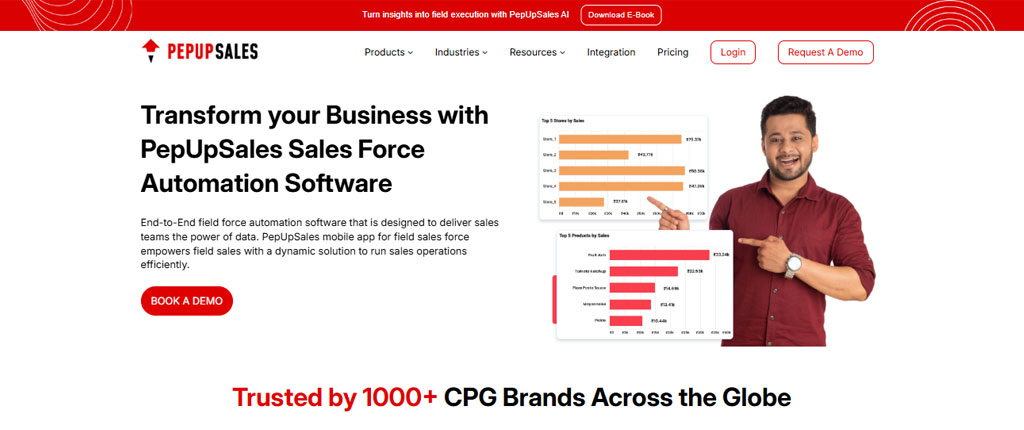
PepUpSales is an integrated SFA and DMS platform built specifically for enterprise FMCG, CPG, building materials, automotive, pharma, and distribution businesses operating across India, Africa, the Middle East, and Southeast Asia. Instead of stitching together three separate vendors, it runs field sales tracking, distributor stock management, van sales, retailer ordering, and visual merchandising from one system.
Core Features
- Real-time sales force tracking with GPS-verified beat plans and outlet coverage reporting
- Full DMS — primary and secondary sales tracking, stock reconciliation, and claim management at the distributor level
- Van sales and ready-stock billing for FMCG brands running direct delivery routes
- Retailer app and dealer portal for order placement without a rep in the loop
- Native integration with SAP, Oracle, Microsoft, Tally, and Zoho, without custom middleware
- PepUp AI Suite for demand forecasting and beat-plan optimization
Real-World Use Case
Parle Agro, one of India’s largest beverage companies, runs a distribution network reaching millions of outlets across thousands of SKUs. The team had strong sales operations already, but struggled to sync execution data across geographies. Stock movement visibility lagged, which slowed decisions at the top. Consolidating on PepUpSales gave them a single view from distributor to outlet.
Pernod Ricard‘s sales development team reported a similar shift. Field visibility improved and decisions moved faster once real-time data replaced fragmented reporting across regions.
Where PepUpSales Wins
The biggest advantage is that PepUpSales doesn’t force enterprises to choose between SFA depth and DMS depth. Most competitors are strong at one and treat the other as an afterthought. Pricing is also built for scale across emerging markets, useful if you’re rolling out across India and then expanding into the Middle East or Africa, since you’re not renegotiating with a new vendor at every stage.
Where It Falls Short
Smaller teams running under 50 reps in a single city may find the platform more capability than they actually need. It’s built for complexity, and that shows up as a steeper initial setup than a lightweight CRM plugin.
2. Salesforce
Salesforce is one of the world’s best-known enterprise CRM platforms. Its strength lies in managing customer relationships, sales processes, service, marketing, commerce, and AI-powered workflows on a broad platform.
Salesforce can be a strong choice for enterprises with complex B2B sales processes and extensive CRM requirements. However, businesses focused heavily on FMCG-style retail execution may need additional configuration or specialized applications for workflows such as outlet-level order capture, beat planning, distributor operations, and field execution.
3. SalesDiary
SalesDiary positions its platform around field sales automation for Indian distribution businesses. Its capabilities include route optimization, order and return management, sales workforce tracking, geo-tagging, offline operations, collections, promotions, and shelf-related activities.
Its offline-first approach is particularly relevant for Indian field teams working across Tier-2 and Tier-3 markets. SalesDiary is worth considering for businesses that want a dedicated field sales platform with a broad set of sales execution workflows.
4. Botree
Botree has built its platform around distribution operations, with SFA and DMS capabilities designed for CPG, FMCG, and related industries.
Botree SFA includes route and visit sequencing, order capture, scheme visibility, dashboards, nudges, attendance, and performance management. Botree also states that its SFA integrates with DMS, ERP, CRM, and accounting systems through APIs.
For enterprises looking for a broader route-to-market platform, Botree is a relevant option to evaluate.
5. Bizom
Bizom takes a retail-intelligence-led approach to SFA. Its platform covers order management, van sales, trade promotions, collections, merchandising, inventory visibility, outlet audits, attendance, PJP planning, and claims.
Bizom also places strong emphasis on AI-driven recommendations, beat optimization, smart merchandising, and outlet-level intelligence. That makes it particularly relevant for consumer brands looking to move from basic activity tracking toward data-driven retail execution.
Comparison at a Glance
| Platform | DMS Depth | Offline Support | Best For | Multi-Country Ready |
| PepUpSales | Strong | Yes | FMCG, CPG, Retail distribution | Yes — India, Africa, Middle East, SEA |
| Salesforce | Needs customization | Limited | CRM-first enterprises | Yes, at higher cost |
| SalesDiary | Moderate | Yes | Mid-market FMCG | Limited |
| Botree | Moderate | Yes | Retail execution-heavy brands | Limited |
| Bizom | Strong (retail) | Yes | Large retail-focused brands | Moderate |
The right choice depends on your operating model. An enterprise CRM requirement is different from a high-volume FMCG field execution requirement.
What Features Should Sales Force Automation Software for Enterprises Include?
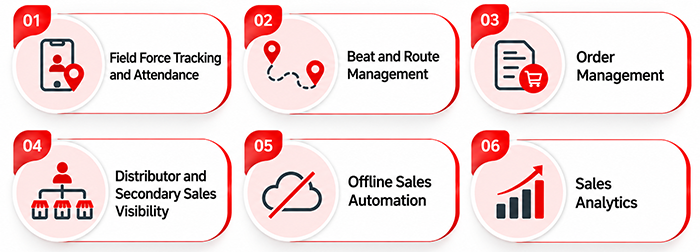
A strong Sales Force Automation software for enterprise should cover the complete field-sales cycle.
1. Field Force Tracking and Attendance
Managers should be able to monitor attendance, location, visit activity, and field productivity. GPS-based verification can provide stronger visibility than manual reporting.
2. Beat and Route Management
Route optimization helps sales teams plan visits around geography, outlet potential, visit frequency, and business priorities. The goal is not simply more visits. It is more productive.
3. Order Management
Reps should be able to review product details, take orders, apply applicable schemes and complete transactions on the spot.
4. Distributor and Secondary Sales Visibility
Enterprise SFA comes into its own when used in conjunction with DMS.
Businesses can match demand in the field with the inventory of the distributors and secondary sales. That assists in recognizing holes prior to they grow into lost sales or stock out.
5. Offline Sales Automation
Field teams should still be able to get customer info, do visits, take orders and record activities when there is no connectivity. When the network comes back on, the data should synchronize back automatically.
6. Sales Analytics
Dashboards should answer real-world questions:
- Which territories are underperforming?
- Which outlets are being missed?
- What is the status of reps’ visit adherence?
- What SKUS are not selling as fast?
- Which areas are seeing more stockouts?
- Which distributors need attention?
This is the difference between data collection and sales intelligence.
How Enterprise SFA Software Improves ROI
The ROI of SFA should not be measured only by software cost versus sales growth.
Look at the operational chain.
Better route planning → lower travel time → more productive visits → better outlet coverage → more orders → stronger sales execution.
There are other savings too. Using digital order capture decreases manual entry. Automated reporting gives a reduction in administrative work. The time to recognise issues with stock can be reduced with real-time distributor visibility. Improving attendance and verification of visits can enhance accountability of the workforce.
These benefits can manifest themselves by customers in various business areas, as seen in PepUpSales customer results. After the implementation of PepUpSales, Mohammed Fakhroo & Bros recorded a 78% increase in market coverage, 82% increase in sales productivity of their field sales reps and merchandisers, and 76% decrease in stockout.
This is why enterprise SFA should be considered an operational investment, rather than just another subscription to software.
Common Challenges When Adopting SFA Software for Enterprises
Even the right platform runs into friction during rollout. Three issues come up repeatedly.
Distributor resistance to new reporting. Informal stock tracking is a tactic that was used by distributors who initially resist structured DMS reporting. Faster adoption on platforms that have an app that is easy to use by the distributor, rather than a dashboard.
ERP integration delays. Multiple companies that are operating SAP or Oracle tend to underestimate the time it takes to integrate. Do not accept a general integration timeline from the vendors and instead request their exact ERP version integration timelines.
Field rep adoption in low-connectivity areas. Mobile data coverage is poor in rural and semi-urban areas in India. If a platform is limited to the web, it will display missing data in the field within the first month. Offline-first architecture is not a choice for pan-India rollouts.
Final Verdict
The best enterprise SFA software in India is not necessarily the platform with the longest feature list. It is the one that fits your sales structure, distribution model, field conditions, integration requirements, and growth plans.
For enterprises managing CPG, FMCG, pharma, consumer durable, or distribution-heavy operations, PepUpSales offers a particularly strong combination of field sales automation and distribution management.
Its ability to connect field teams, distributors, retailers, orders, routes, secondary sales, and business intelligence makes it more than an attendance or salesman location tracking software. It provides a connected layer for managing sales execution from the market to the management dashboard.
If your business is evaluating Sales Force Automation software for enterprise, the next step should be practical: map your current field workflow, identify the biggest execution gaps, and test how each platform handles them. Book a demo with PepUpSales to see how the platform handles your specific distribution structure.
Frequently Asked Questions
1. What is the best enterprise SFA software in India?
There is no single platform that fits every enterprise. PepUpSales is great for companies that are CPG, FMCG and Distribution driven, as it offers SFA and DMS along with field execution, route management, analytics and enterprise integrations.
2. What is the difference between SFA and DMS?
SFA is responsible for sales field execution – which involves visits, attendance, routes, orders and sales activities. DMS automates order management, inventory, billing, and secondary sales for the distributors. Linking both together will provide enhanced end to end visibility.
3. Is Enterprise Sales Force Automation software useful for FMCG companies?
Yes. FMCG companies have big field teams, wide outlet coverage, frequent visits, lots of SKUs, and intricate distribution systems. SFA assists in making these activities digital and coordinating them.
4. Does enterprise SFA tool work without the internet?
There are many modern SFA platforms that offer offline workflows. But, consumers should verify which activities are still available without the Internet and how the activities are synced back when Internet connection is restored.
5. How should companies calculate SFA ROI?
Start with measurable operational KPIs. Measure and compare the number of productive calls, outlet coverage, order value, reporting time, travel efficiency, stock-outs, sales productivity and administrative workload before and after implementation.


