

Distribution visibility is one of the biggest operational challenges for brands across Africa. Most companies can track what leaves the factory. But once products enter distributor warehouses, that visibility disappears almost entirely.
Which distributors are running low on stock? Which SKUs are selling at the retail level? Which of them are stacking up? For days or weeks these questions remain unanswered without adequate systems.
Distributor Management Software for Africa fills these key gaps. By providing a company with a real-time picture of its whole distribution chain, from the primary sales point at its factory level to its retail shelf, it ensures that brands are never caught out in the cold. To select the right solution, however, it is important to first understand what makes African distribution truly unique.
Why African Distribution Is Different
African markets are more complicated than any other market. General solutions that are suitable in developed markets do not work in this case. Thus, brands require mechanisms that are designed to meet African requirements.
1. The Primary-Secondary Sales Visibility Gap
Primary sales are not difficult to track by the majority of brands. They are aware of what comes out of the factory. Nevertheless, they become invisible when goods are sold in distributor warehouses.
This poses grave obstacles. Such questions as: How many stocks does this or that distributor have? or “What are the selling products? remain unanswered.
This is solved by distributor management systems of Nigeria which track the primary and secondary sales. As a result, you get the whole picture from the factory to the retail shelf.
2. Traditional Trade Dominance
In Nigeria, Ghana, and Uganda, the proportion of trade in traditional accounts for more than 90% of the FMCG sales. Even Kenya that is usually thought of as being more developed, 70% of sales occurs in the traditional outlets. African retail is fuelled by small shops, kiosks and dukas.
Distributor management software for Africa should have to deal with this fact. You will have to have your system to capture data of thousands of small outlets.
3. Infrastructure Challenges
Roads are in bad condition and thus logistics is costly. Africa has eight times the cost of transport as compared to the world average. Power supply is unreliable, and there is a huge fluctuation in internet connection.
Field sales tracking systems in Tanzania require high offline functionality. Constant connectivity cannot be relied upon by teams. In addition, the solutions should be able to operate on low-data basic smartphones.
Critical Problems African Brands Face Daily
The knowledge of real-life difficulties is the reason as to why contemporary distributor management is important.
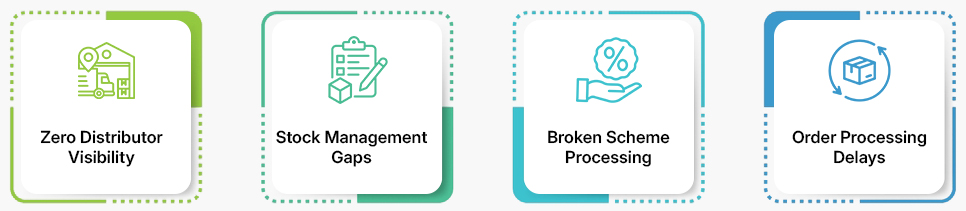
Zero Distributor Visibility
The majority of brands are not able to respond to straightforward questions. What is the inventory of the distributors? What are daily sales? Which products move slowly?
Planning failures are brought about by this invisibility. Distributors end up with fast-movers and low inventory with slow inventory. Also, the compliance to the scheme cannot be verified.
These visibility issues are solved by the distribution software of Ghana with real-time tracking.
Stock Management Gaps
Ineffective inventory control generates crises all the time. Stockouts of the popular products lose sales. In the meantime, slow moving inventory occupies warehouse space and capital.
Out of date goods generate further losses. Unless they are tracked, products that are about to expire are forgotten. Moreover, there is random product rotation.
Broken Scheme Processing
Trade schemes are complex. The sales teams find it difficult to use them appropriately. The process of claims by hand takes weeks.
Errors cost money. There are loopholes that are exploited by distributors. It is almost impossible to verify without systems. As a result, brands lose money due to making false claims.
Order Processing Delays
The process of paper-based ordering is slow and inaccurate. WhatsApp ordering is superior yet not organized and traced.
Everything is digitized in DMS software of African markets. Orders go directly through the field to the system. The processing is quicker and has fewer mistakes. Thus, the time of deliveries is smoothed out.
Key Features to Look for in Distribution Management Software for Africa Markets
However, not all DMSs are suitable for use in Africa. These are the skills that really count.
1. Complete Sales Visibility
The system should be able to record sales at all levels. Primary sales are factory to distributor sales. Secondary sales offer insights into actual distributor/retailer activity. This two-way visibility with the help of the Best distributor management software in Nigeria allows for demand forecasting and avoids stock imbalances that result in lost revenue.
2. Real-Time Inventory Management
It is crucial to track livestock on all distributor locations. The system should alert users to low stock levels before they become a stock-out. Batch and expiry tracking will allow for the identification of products that are coming to the end of their life and can be rotated or moved quickly. Importantly, this must be able to operate even with partial Internet access.
3. Automated Order Processing
Distributors require an easy and quick mobile ordering experience. The system should automatically reject orders if it can’t handle the credit limits or inventory. Orders for fulfilment are then automatically routed via approval workflows without the need for manual input, thus cutting down on processing time.
4. Smart Scheme Management
The software must be able to process the schemes automatically at the time of the order, support the digital processing of the claim with photo and invoice upload, and have the ability to process the scheme definition. This is a level of built-in intelligence that is necessary for complex African trade structures, with multiple layers of incentives and conditions.
5. Distributor Self-Service Capabilities
Distributors can now see the stock, see if they are eligible for a scheme and then order their own stock, using modern distributor management platforms. This minimizes the need for costly and infrequent sales rep visits. As a result, across the network, order frequency becomes better and there are fewer stockout incidents.
6. Seamless ERP Integration
The DMS needs to be integrated with existing ERP system like SAP, Sage, Tally or Busy. Data should flow between systems automatically and should generate an invoice automatically. This prevents data duplication and maintains consistency of data throughout the business.
7. True Offline Functionality
This isn’t optional in African markets, it’s a minimum requirement. Distributors need to be able to place orders, update stock and make payments without an internet connection. On reconnection, all data should be synced automatically and securely.
How Distribution Management System Solves African Distribution Challenges
Some of the Best Distribution Management Softwares like PepUpSales understands African distribution deeply. Our solution addresses real problems that brands and distributors face daily.
1. Built for Africa’s Infrastructure Reality
We designed PepUpSales specifically for challenging African environments. Offline functionality is fundamental, not an add-on.
Distributors work confidently regardless of internet availability. All critical operations function offline. Data syncs seamlessly when connection returns. This reliability prevents frustration and maintains productivity.
2. End-to-End Distribution Visibility
PepUpSales provides complete visibility across your distribution network. Track primary sales from factory to distributor. Monitor secondary sales from distributor to retailer.
Real-time dashboards show stock levels across all locations. You spot problems before they impact sales. Additionally, forecasting becomes accurate because you see actual demand patterns.
3. Distributor Empowerment Tools
Our self-service distributor portal transforms distributor operations. They view stock levels, place orders, and track schemes independently.
This reduces their dependence on sales rep visits. Consequently, orders happen more frequently with better timing. Stock availability improves throughout the network.
4. Automated Scheme Intelligence
PepUpSales handles complex trade schemes automatically. The system calculates applicable schemes during order entry. Manual errors disappear completely.
Claims processing becomes fast and transparent. Digital documentation replaces paper. Verification happens quickly. Therefore, both brands and distributors stay happy with shorter processing times.
5. Powerful Yet Simple Interface
We balance capability with usability. PepUpSales offers enterprise features through an intuitive interface.
Training time decreases dramatically. New users become productive quickly. Moreover, the learning curve is gentle even for less tech-savvy team members.
6. Scalable Across African Markets
Whether you operate in one country or across Africa, PepUpSales scales with you. Multi-currency support handles different national currencies. Multiple languages accommodate local teams.
Distributor management systems for Tanzania have different needs than those for Ghana. PepUpSales adapts to local requirements while maintaining consistent core functionality.
7. Strong Analytics for Smart Decisions
Our analytics turn data into actionable insights. Standard reports cover all key metrics. Custom reports address your specific needs.
Identify top and bottom performers quickly. Spot market trends early. Additionally, forecast accurately using historical patterns and current data.
8. The Future of Distribution in Africa
Technology transforms African distribution rapidly. AI provides sophisticated demand forecasting and anomaly detection. Mobile devices become primary platforms with voice interfaces simplifying operations.
Real-time expectations rise. Distribution management software for Ghana and other markets must provide instant visibility. Direct retailer connections blur B2B and B2C lines.
DMS platforms must facilitate these connections. Distributor roles evolve but remain crucial for logistics and credit support.
PepUpSales delivers proven results for brands across Nigeria, Kenya, South Africa, Ghana, Tanzania, and Zambia. Our solution combines powerful capabilities with African market understanding.

Final Words
In Africa, distribution visibility is not a key competitive advantage, it’s a prerequisite for sustainable growth. Without full visibility into distributor stock levels, daily sell-out data, and trade scheme compliance, brands are making critical decisions in the dark. The price of that “invisibility” builds up over the years due to lost sales, poor planning and a diminishing network of distributors.
PepUpSales is empowering brands in Africa to have control over their distribution networks. These are some of the results that brands are already getting with PepUpSales, thanks to improved stock availability, more robust distributor relationships and measurable sales improvements.
To see what purpose-built distribution management can do for your business, schedule a free Distribution Management Software demo with PepUpSales today.
FAQs
1. What is distribution management software and how does it work in African markets?
A distribution management software for Africa is a platform that allows brands to have real-time control over their distribution network. It monitors primary sales from the factory to the distributor in African markets, secondary sales from distributor to retailer, inventory levels, trade schemes, and field team activity. It supports traditional trade channels such as kiosks, dukas and general stores, which are the predominant channels for FMCG sales throughout Nigeria, Ghana, Kenya and other markets in Africa.
2. How does a DMS Software help manage traditional trade outlets across Africa?
The majority of FMCG sales in markets like Nigeria, Ghana and Uganda are from traditional trade, which includes small shops, kiosks and dukas. The ideal DMS will be able to capture outlet level sales data, monitor retailer ordering habits, and provide field teams with tools to service thousands of smaller retailers efficiently. PepUpSales delivers this with its Retailer App and the route-to-market solution for traditional high volume retail.
3. Can distributor management software handle complex African trade schemes and promotions?
Yes, and this is one of the most valuable capabilities for African brands. The market in Africa is layered with trade schemes, with multiple conditions and distributive tiers, and claim cycles. PepUpSales automates the entire scheme process including the scheme definition, automatic application at the point of order entry and digital claims processing with automatic upload of photos and invoices.
4. Which African countries does PepUpSales support?
PepUpSales has operations in over 20 countries including the major African markets of Nigeria, Kenya, South Africa, Ghana, Tanzania, Uganda and Zambia. It allows brands to use multiple currencies and local languages and is well suited for brands that have distribution operations across Africa from one system.
5. How does a distribution management system for Kenya improve stock availability across African markets?
One of the most common distribution failures in Africa is poor stock management. Fast moving SKUs are depleted and slow moving SKUs are sitting in warehouses. PepUpSales offers real-time stock tracking at all distributor sites, alerts for low stock, and batch tracking and expiry dates. This means that brands can now take action before the stock out occurs and not after sales are made.
6. How does PepUpSales integrate with ERP systems used by African businesses?
PepUpSales integrates with widely used ERP systems in African markets, such as SAP, Sage, Tally, and Busy. Data is automatically loaded into the ERP, invoices are generated automatically and no data is duplicated between systems. Especially for brands with existing finance and inventory systems who want their DMS to integrate with them easily.


