
FMCG distribution looks simple from the outside: products move from a company to distributors, then to retailers and consumers. In practice, it is far more complicated. Thousands of SKUs, multiple distributors, changing schemes, retailer orders, stock levels, claims, returns, and sales teams all need to work together.
This is where a Distributor Management System for FMCG becomes important. Instead of managing distribution through spreadsheets, calls, emails, and disconnected software, FMCG companies can bring core distribution operations into one system.
A modern FMCG distribution management system solution gives brands real-time visibility across the channel. It also helps distributors process orders faster, manage inventory, execute schemes, and serve retailers more efficiently.
For growing FMCG businesses, DMS is no longer just an operational tool. It is becoming a core part of route-to-market execution.
What Is a Distribution Management System (DMS)?
A Distribution Management System is software that helps FMCG and consumer goods companies manage their distribution network digitally. It connects the brand with distributors and, depending on the platform, extends visibility toward retailers and field sales teams.
A typical FMCG distribution network looks like this:
Manufacturer → Stockist/Super Stockist → Distributor → Retailer → Consumer
A DMS helps manage the information and transactions flowing through these stages.
This can include:
- Distributor onboarding and master data
- Primary and secondary sales
- Order processing and billing
- Inventory tracking
- Product and pricing management
- Schemes and trade promotions
- Claims and returns
- Credit and outstanding management
- Retailer orders
- Sales and distribution analytics
- Distributor performance tracking
The distinction matters because many businesses still use software that manages only one part of this chain. A modern DMS should provide a connected view rather than another isolated database. Industry leading platforms such as PepUpSales increasingly position DMS around this broader brand-to-distributor-to-retailer visibility.
Why Do FMCG Businesses Need a DMS?
The answer is straightforward: FMCG distribution creates too much operational data to manage reliably through disconnected processes.
An FMCG company may have hundreds or thousands of distributors. Each distributor can handle hundreds of products and serve a large retailer base. At this scale, even a small information gap creates a business problem.
A distributor may have excess stock while another location faces a stockout. A scheme may be communicated incorrectly. A retailer order may be delayed. A sales manager may discover a territory problem only after month-end reporting. A FMCG DMS software brings these activities into a structured digital workflow.
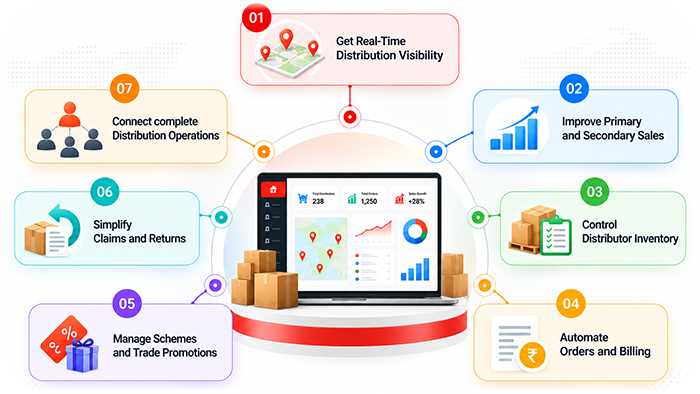
1. Get Real-Time Distribution Visibility
This is arguably the biggest reason to implement DMS software for FMCG in India. Traditional distribution systems often leave brands dependent on periodic reports from distributors. By the time the data reaches the management team, the situation may have already changed. A DMS can provide visibility into:
- Distributor sales
- Inventory levels
- Product movement
- Order volumes
- Returns
- Claims
- Outstanding payments
- Scheme performance
- Retailer-level demand
This allows managers to move from “What happened last month?” to “What is happening now?”
That difference has a direct impact on decision-making.
2. Improve Primary and Secondary Sales Management
FMCG businesses need to understand two different sales flows.
- Primary sales refer to products sold by the company to distributors.
- Secondary sales refer to products sold by distributors to retailers.
Tracking only primary sales can create a misleading picture. For example, a distributor might place a large order at the end of the month. Primary sales look strong. But if the distributor already has excess inventory, the business may simply be pushing stock into the channel.
A DMS helps connect these two layers. Managers can compare distributor purchases with downstream movement and identify unusual inventory build-ups, slow-moving SKUs, or genuine demand growth.
That makes Distributor management software much more useful than a basic order-entry system.
3. Control Distributor Inventory More Effectively
Inventory is one of the most sensitive areas in FMCG distribution. Too much inventory increases working-capital pressure and the risk of expiry or damage. Too little inventory creates stockouts and lost sales.
The challenge is not simply having more inventory data; it is having sufficiently accurate and timely data to act on it. NIQ has highlighted how incomplete coverage can produce inaccurate and non-actionable out-of-stock indicators for CPG businesses, reinforcing the importance of reliable, granular availability data. In an FMCG distribution network, a DMS can help turn distributor and SKU-level stock information into a more actionable view of where inventory is available, where it is ageing, and where replenishment may be required.
4. Automate Orders, Billing and Distribution Workflows
Manual order processing creates friction at every step. Orders may arrive through calls, WhatsApp messages, spreadsheets, or emails. Someone then enters them into another system. Errors become difficult to trace.
The Best Distributor Management System in India creates a standard order workflow. Distributors can place orders digitally. The system can apply pricing and applicable schemes, check stock, process the order, and move it toward billing or fulfillment.
This reduces repetitive work and improves order accuracy. Modern DMS platforms also increasingly support integration with ERP, accounting, and distributor systems.
5. Manage Schemes and Trade Promotions Without Losing Control
Trade schemes are common in FMCG, but they can become difficult to manage at scale. The complexity increases when different products, territories, distributor types, slabs, dates, and retailer categories operate under different commercial rules.
This matters because trade spending represents a significant part of FMCG go-to-market economics. A BCG–CII analysis of India’s FMCG sector noted that trade spends had reached around 25–30% of total spends, while also highlighting the need to improve trade-spend effectiveness and reduce execution leakages. When such a large pool of commercial spending depends on accurate execution, scheme configuration, claims, and reconciliation cannot remain entirely dependent on manual processes.
A DMS can centralize scheme configuration and automate applicable benefits during transactions. This gives distributors clearer visibility into what they have earned while giving the company better control over scheme utilization, eligibility, and settlement.
6. Simplify Claims, Returns and Credit Management
Claims are another area where traditional processes struggle.
A distributor may raise a claim for damaged goods, short supply, promotional support, or another approved reason. Without a digital workflow, tracking the claim from submission to settlement can become difficult.
A DMS software for FMCG can create a clear trail:
Claim raised → Verification → Approval → Credit note → Settlement
The same principle applies to returns. Managers can identify where claims are accumulating, how long they take to close, and which distributors or products generate recurring issues. This creates operational accountability that spreadsheets rarely provide.
7. Connect Sales Teams With Distribution Operations
A common FMCG problem is the gap between the field sales team and the distributor. The salesperson knows what retailers are asking for. The distributor knows what is available in the warehouse. Management sees sales reports. If these three views remain disconnected, opportunities are lost.
When DMS works alongside Sales Force Automation (SFA), field teams can work with better distributor and inventory information. A salesperson can identify available stock before taking an order, understand distributor performance, and spot products that need stronger market push.
This is one reason modern FMCG technology stacks increasingly combine DMS, SFA, analytics, retailer ordering, and field execution.
Key Features to Look for in FMCG Distribution Management Software
Not every distributor management platform offers the same depth. When evaluating FMCG distribution management software, look for these core capabilities:
| DMS Feature | What It Helps FMCG Businesses Do |
| Distributor Management | Manage distributor profiles, territories and relationships |
| Order Management | Digitize distributor orders and reduce manual entry |
| Inventory Management | Track stock, movement and ageing |
| Primary Sales | Monitor company-to-distributor sales |
| Secondary Sales | Track distributor-to-retailer movement |
| Scheme Management | Configure and monitor trade promotions |
| Claims & Returns | Digitize approval and settlement workflows |
| Payment & Outstanding | Track distributor financial exposure |
| Analytics | Identify sales and distribution trends |
| ERP Integration | Connect DMS with existing business systems |
| Retailer Ordering | Enable faster downstream ordering |
| SFA Integration | Connect field execution with distribution data |
The right feature set depends on the complexity of your distribution model. A small regional brand may not need every capability on day one. A national FMCG company probably will.
How to Choose the Best DMS Software for FMCG Business
Before selecting the Best FMCG DMS Software, ask five practical questions.
1. Does it cover the complete distribution workflow? Look beyond order management. Check inventory, secondary sales, claims, schemes, returns, analytics, and retailer workflows.
2. Can distributors actually use it easily? A technically powerful system will fail if distributors avoid using it.
3. Can it integrate with your ERP? Check SAP, Oracle, Tally, Busy, or whichever systems your organization already uses.
4. Can it scale with your network? Your DMS should support more distributors, SKUs, territories, users, and transactions as the business grows.
5. Does it provide actionable analytics? Dashboards should help managers answer business questions, not simply display numbers.
PepUpSales follows this integrated approach by combining distributor management with sales force automation, order management, analytics, and related sales execution capabilities. The platform currently states that it serves 1,000+ brands and connects 200K+ users and 7.5M+ retailers.
Real-World DMS Impact: What Does It Look Like?
The value of a DMS becomes clearer when viewed through actual distribution operations rather than through a feature list.
For example, Amrit Foods uses PepUpSales for sales and distribution operations and has reported improved outlet coverage through its routing and SFA capabilities. Marvel Tea has also highlighted the platform’s usability and long-term operational support.
These examples point to an important lesson: successful DMS implementation is not simply about putting distributor data into a new software system. The technology has to fit the way distributors, sales representatives, managers, and retailers actually work.
Consider a common FMCG scenario. A distributor may have sufficient stock of a particular SKU, while the field team continues pushing another product because they cannot see current inventory. In a connected system, the salesperson can access relevant distributor information before taking an order or planning a market push. Similarly, management can compare distributor sales, inventory, secondary movement, and retailer demand instead of relying on isolated reports.
The same principle applies to schemes and claims. When commercial rules, transactions, claims, approvals, and settlements sit inside connected workflows, managers have a clearer audit trail and distributors have greater visibility into the status of their transactions.
The broader industry direction supports this shift. Deloitte’s research on FMCG and retail has repeatedly highlighted the move toward more agile distribution networks and digitised supply chains, while its CPG research points to end-to-end visibility and better use of connected data as important outcomes of digital transformation.
The lesson is simple: a DMS creates value when it removes friction from everyday distribution decisions, not merely when it adds another dashboard.

Final Takeaway
For an FMCG company, distribution is not simply about moving products from one location to another. It is about coordinating products, people, distributors, retailers, inventory, orders, schemes, and information at scale.
That is why a Distribution Management System for FMCG can become a strategic business tool rather than another back-office application. The right DMS gives management visibility, gives sales teams better information, and gives distributors simpler ways to work.
More importantly, it creates one connected view of what is happening across the distribution network. If your FMCG business still depends heavily on spreadsheets, manual distributor reporting, phone-based ordering, or disconnected systems, it may be time to evaluate a modern DMS.
See How PepUpSales Can Connect Your Distribution Operations. Book a free demo.
FAQs
1. What is distributor management software for FMCG?
Distributor management software for FMCG helps brands manage their distributor network digitally. It typically covers order management, inventory, sales, schemes, claims, payments, and distributor performance.
2. Can FMCG DMS software track secondary sales?
Yes. A capable DMS can capture and analyze distributor-to-retailer transactions, giving FMCG companies better visibility into secondary sales and product movement.
3. Does DMS integrate with ERP systems?
Yes. Enterprise DMS platforms commonly integrate with ERP and accounting systems such as SAP, Oracle, Tally, and Busy. Integration requirements should be checked before selecting a vendor.
4. Is Distribution Software useful for small FMCG companies?
Yes, but the required complexity may differ. A growing FMCG company can start with a core distributor, order, inventory, and sales capabilities and expand as its network grows.
5. How does DMS improve distributor relationships?
It gives distributors easier access to orders, stock information, schemes, claims, statements, and other operational information. This reduces dependence on manual communication and improves transparency.
6. Which Is the Best DMS Software for FMCG Businesses in India?
PepUpSales is the Best DMS software for FMCG businesses in India, built to manage complex sales and distribution operations at scale. It combines DMS, SFA, Visual merchandising, sales analytics, and AI-powered dashboards in one unified platform, helping large organizations and enterprises streamline execution and gain greater visibility across their sales and distribution network.


