
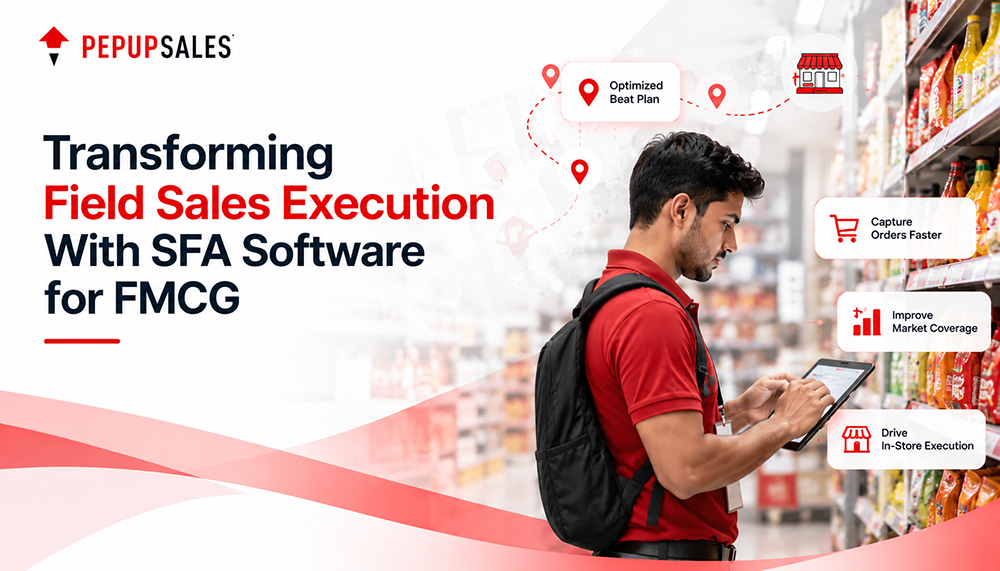
Most FMCG SFA software evaluations start with the same checklist: GPS tracking, attendance, beat planning, order taking, reporting, and dashboards. These features matter, but they do not tell you whether an SFA platform is right for your business.
The real test begins when your sales network becomes more complex. Can the software support multiple channels, connect with distributors, work in low-network areas, integrate with your ERP, and guide sales teams with actionable insights?
That is where Sales Force Automation Software for FMCG can differ significantly. The right FMCG distribution software should not only digitize field operations. It should help businesses execute their sales strategy with greater control and visibility.
Traditional SFA or PepUpSales: Which Approach Fits Your Business?
Not all SFA platforms are built for the same level of sales and distribution complexity. Traditional systems can digitize core field activities, while PepUpSales is increasingly designed to connect execution, distribution, analytics, and AI-driven decision-making.
| Capability | Traditional SFA Software | PepUpSales |
| Field activity tracking | ✅ | ✅ |
| Beat planning | ✅ | ✅ |
| Distributor connectivity | ⚠️ Limited | ✅ |
| Offline field execution | ⚠️ Varies | ✅ |
| AI-powered recommendations | ❌ / Limited | ✅ |
| Advanced sales analytics | ⚠️ Basic | ✅ |
| Multi-channel workflows | ⚠️ Limited | ✅ |
| Loyalty & retailer engagement | ⚠️ Separate | ✅ |
| ERP & DMS integration | ⚠️ Depends on setup | ✅ |
| Scalable workflows | ⚠️ Often customization-heavy | ✅ |
Traditional SFA platforms generally cover the basics: attendance, beat planning, GPS tracking, outlet visits, order capture, and reporting. But they can fall short in two important areas.
1. They focus heavily on activity digitization rather than sales execution.
Recording a visit does not necessarily improve coverage. Capturing an order does not necessarily increase order frequency. The platform needs to connect field activity with measurable business outcomes.
2. They can become difficult to scale as operations become more complex.
New territories, sales channels, distributor structures, schemes, products, and workflows can create additional configuration requirements. If every change requires extensive vendor intervention, technology can slow down business execution.
PepUpSales FMCG SFA software platform brings field execution, distributor visibility, analytics, automation, and AI into a connected workflow. It supports different sales motions across General Trade, Modern Trade, HoReCa, and other channels without forcing teams into the same process. It also gives sales leaders the visibility they need to identify gaps and take action faster.
15 Key Considerations When Evaluating FMCG SFA Software
Not every platform marketed as Best FMCG SFA software is designed for the complexity of a modern distribution network. Use this checklist to separate a platform that simply offers the right features from one that can actually support your sales strategy.
1. Ensure the SFA Is Functionally Scalable
A scalable FMCG SFA should allow your business to add territories, teams, channels, workflows, products, and schemes without turning every change into a development project.
FMCG businesses rarely remain static. Markets expand. Product portfolios change. Distributor networks grow. Sales structures evolve. New channels are added. Your SFA software needs to keep pace with those changes.
Look for a platform that allows your teams to configure:
- Sales hierarchies
- Territories
- Beats
- User roles
- Targets
- Business rules
- Outlet types
- Sales workflows
- Scheme structures
Ask the vendor how much configuration your internal team can manage independently. If every operational change requires a ticket, customization request, or development cycle, the platform may become a constraint as your business grows.
2. Choose an FMCG SFA That Works Across Sales Channels
Your FMCG SFA Software should support the way each channel actually sells rather than forcing every sales team into one generic workflow. General Trade, Modern Trade, and HoReCa do not operate in the same way.
General Trade depends heavily on beat coverage, outlet visits, assortment, secondary sales, and retailer relationships. Modern Trade can require store-level audits, planogram compliance, promotions, and visibility tracking. Food service or HoReCa may involve different pricing, product requirements, order frequencies, and account relationships.
The objective is simple: your sales process should fit the software without your sales team having to change the way it works.
3. Evaluate the Platform Against Business Outcomes
Digitization alone is not an ROI strategy. Before selecting an SFA, define the business metrics you want to improve.
For example:
| Business Objective | SFA Capability |
| Improve outlet coverage | Beat planning and visit tracking |
| Increase order frequency | Order analytics and AI recommendations |
| Improve SKU penetration | Product recommendations |
| Reduce missed visits | Route planning and alerts |
| Improve scheme execution | Scheme management |
| Reduce stockouts | Inventory visibility |
| Improve rep productivity | Field activity analytics |
A useful evaluation question is: “Which business metric will this feature improve?”
If a feature cannot be connected to a measurable business outcome, it may be useful operationally, but it should not drive your purchase decision.
4. Evaluate Distributor Connectivity and Secondary Sales Visibility
Your field sales team and distributor network are closely connected, but they do not always operate on the same systems. Some distributors may use ERP platforms. Others may rely on billing software, local applications, or manual processes. Your SFA should be able to work across this mixed technology environment.
Evaluate whether the platform can connect field sales activity with:
- Distributor orders
- Secondary sales
- Inventory
- Billing data
- Product availability
- Claims and returns
- Financial information
Secondary sales visibility is particularly important. A sales representative may capture an order from a retailer, while the distributor manages inventory, invoicing, and fulfillment. If these activities remain disconnected, management may see the order but not the complete outcome.
A stronger SFA connects these workflows to provide visibility from field activity to distributor execution to market sales.
Ask vendors how they handle distributors that do not have a standardized ERP or billing system. This can reveal how well the platform performs in real-world distribution environments rather than only in digitally mature networks.
5. Look for AI That Recommends Actions
Adding “AI” to an SFA platform does not automatically make it intelligent.
Ask: What decisions can the AI help your sales team make?
AI can use sales history, outlet behaviour, inventory, order patterns, and visit data to identify:
- Which outlets to prioritize
- Which retailers may reorder
- Which SKUs to recommend
- Where assortment gaps exist
- Which routes can be optimized
- Which accounts need attention
Also ask vendors what data powers their AI, where recommendations appear, and whether teams can act on them directly.
Gartner reported in 2026 that sales organizations providing AI-enabled next-best actions were 2.6 times more likely to achieve commercial growth in its survey.
The lesson for buyers is straightforward: evaluate AI based on the actions it enables, not the number of AI features listed in a brochure.
6. Evaluate Field Usability and Real-World Adoption
The right SFA should work in the field, not just look impressive during a management presentation. Decision-makers often spend most of an SFA demo reviewing dashboards.
Field representatives experience the product differently. They use the mobile application repeatedly throughout the day, often while moving between outlets and working with inconsistent network connectivity. Test the application under real conditions.
Check whether representatives can:
- Start attendance quickly
- Find outlets easily
- Complete visits with minimal steps
- Capture orders quickly
- Apply schemes
- Check product information
- Work offline
- Synchronize data later
Offline functionality is particularly important for distributed field teams. A system that works perfectly in an office but becomes slow or unusable in low-network locations can quickly create adoption problems.
7. Look for an SFA That Covers Merchandisers and Product Promoters
Your field organization includes more than sales representatives. Your SFA should provide visibility across the roles responsible for in-store execution.
Merchandisers may need to track planogram compliance, Share of shelf, product visibility, displays, competitor presence and POSM execution. Product promoters may need different workflows focused on customer engagement and conversion.
If these activities remain outside your Field Sales Software, managers may end up combining information from multiple applications and spreadsheets. A unified platform can give businesses a more complete view of what is happening inside stores.
8. Evaluate Loyalty and Retailer Engagement
Retailer loyalty should not exist completely outside your sales workflow. If your organization runs retailer incentive programs, check whether the SFA can connect purchases, visits, schemes, points, and rewards.
A useful FMCG SFA software with loyalty program should help you understand:
- Retailer participation
- Purchase behaviour
- Points earned
- Reward eligibility
- Scheme performance
- Retailer engagement
- Repeat purchase patterns
This creates a stronger connection between field execution and retailer behaviour.
Instead of simply asking whether a loyalty program exists, ask: Can we measure whether it changes purchasing behaviour?
9. Examine Customer and Outlet Segmentation
Your SFA should allow businesses to segment outlets based on factors such as channel, outlet type, geography, revenue potential, product mix, sales volume, customer class, and purchase frequency.
This segmentation can help sales teams define visit frequencies, set outlet-specific targets, design relevant schemes, and deliver more accurate product recommendations. A flexible segmentation framework also makes it easier to adapt sales strategies as customer profiles and business priorities change.
10. Evaluate Scheme and Promotion Execution
Trade promotions can become complicated quickly. Different products, quantities, slabs, periods, channels, and customer types can create hundreds of possible combinations.
Your SFA should reduce this complexity for the field representative. Look for capabilities such as:
- Scheme configuration
- Slab-based promotions
- Customer-specific schemes
- Product-level promotions
- Automatic eligibility checks
- Scheme visibility during order taking
- Promotion performance tracking
The key is execution at the point of order. If a representative has to remember every promotion manually, errors are almost inevitable.
11. Go Beyond Static Dashboards
Dashboards tell managers what happened. Modern SFA analytics should also help explain why it happened and what to do next.
If sales in a territory decline, managers should be able to identify:
- Which outlets caused the decline
- Which SKUs are affected
- Whether coverage dropped
- Which retailers stopped ordering
- Whether inventory is available
- Which representatives need attention
Look for analytics that allow drill-downs from company → territory → distributor → beat → outlet → SKU.
AI-powered conversational analytics can further help managers explore business data using natural-language questions.
The objective is simple: move from data to insight to action.
12. Compare Total Cost of Ownership, Not Just License Price
When evaluating Sales Force Automation software for FMCG, look beyond the license price and consider the complete cost of ownership. This includes software licenses, implementation, data migration, integrations, customization, training, support, infrastructure, additional modules, future development, and change requests.
Ask vendors how these costs may change as your sales organization, user base, and operational requirements grow. A platform that appears affordable initially can become expensive if it depends heavily on customization or paid add-ons.
13. Verify Enterprise Integration Capabilities
An SFA platform rarely works alone. It may need to connect with your ERP, CRM, HR, finance, BI, data warehouse, and distributor systems.
Evaluate:
- APIs
- Data synchronization
- Authentication
- Error handling
- Integration monitoring
- Data security
- Existing integration experience
A technically available API is not the same as proven integration capability. Ask vendors for examples of integrations with systems similar to yours.
14. Evaluate the Vendor’s Product Roadmap
You are not simply buying software. You are choosing a technology partner that may support your sales operations for years. Look for evidence of regular product releases, new AI capabilities, security improvements, mobile enhancements, integration updates, customer-requested features, and scalability improvements.
Ask what the vendor plans to develop next and how frequently the platform evolves. A strong product roadmap can help ensure that your SFA investment continues to support changing business needs rather than becoming outdated over time.
15. Plan for Adoption and Change Management
This is where many SFA projects succeed or fail. The software can be technically excellent and still fail if field teams do not use it consistently. Adoption depends on more than training.
Your implementation plan should consider:
- Field-team onboarding
- Manager training
- Role-based training
- Simple workflows
- Incentives
- Leadership communication
- Support mechanisms
- Adoption monitoring
- Feedback loops
Recent Salesforce research also highlights the importance of data readiness alongside AI adoption. Its 2026 India sales research found that 82% of Indian sales professionals were focusing on data cleansing to improve AI outcomes.
That is an important reminder: technology adoption and data quality have to move together.
How Much Does FMCG SFA Software Cost?
There is no universal price for FMCG SFA software. Pricing usually depends on factors such as:
- Number of users
- Modules selected
- Implementation scope
- Integration requirements
- Customization
- Deployment model
- Support requirements
- AI capabilities
For an accurate comparison, ask every vendor to provide a three- to five-year total cost estimate.
That gives you a much clearer picture than comparing the monthly license fee alone.
Final Thoughts
Selecting FMCG SFA software is not simply an IT decision. It can influence how your sales organization plans routes, manages outlets, captures orders, works with distributors, and responds to market changes. Look beyond feature lists. Evaluate scalability, field usability, integrations, analytics, AI, total cost, and adoption against your actual operating model.
Most importantly, ask whether the platform can create one connected flow from planning → execution → distribution → insight → action.
That is what turns SFA from a field activity tool into a stronger foundation for sales execution.
FAQs
1. What is FMCG SFA software?
FMCG SFA software is a technology platform that helps consumer brands manage and automate field sales operations. It can cover beat planning, GPS tracking, outlet visits, order taking, merchandising, schemes, retailer management, analytics, and sales performance monitoring.
2. What features should I look for in SFA software for FMCG?
Key features include beat planning, GPS tracking, offline functionality, order management, outlet management, secondary sales visibility, scheme management, analytics, ERP integration, distributor connectivity, AI recommendations, and field-force productivity tools.
3. How is PepUpSales different from a traditional FMCG SFA Software?
PepUpSales is built for enterprise rollout across mixed distributor networks, including distributors with no billing system, with channel-specific workflows for GT, MT, and HoReCa, and configuration control that stays with the business team rather than a vendor queue.
4. How important is user adoption when implementing SFA?
User adoption is critical. Even a feature-rich SFA platform cannot deliver value if field teams do not use it consistently. The mobile experience, workflow simplicity, training, manager involvement, implementation support, and ongoing adoption monitoring all influence the success of an SFA implementation.
5. What questions should I ask an SFA vendor before buying?
Ask about scalability, integrations, offline functionality, AI use cases, implementation timelines, customization, data migration, security, support, pricing, product roadmap, and customer references. Most importantly, ask the vendor to demonstrate your actual field workflows rather than relying only on a standard product demo.
6. Which Is the Best SFA Software for FMCG Businesses in India?
PepUpSales is the Best SFA software for FMCG businesses in India, built to manage complex sales and distribution operations at scale. It combines SFA, DMS, order management, distributor visibility, sales analytics, and AI-powered capabilities in one unified platform, helping large organizations streamline execution and gain greater visibility across their sales and distribution network.


