
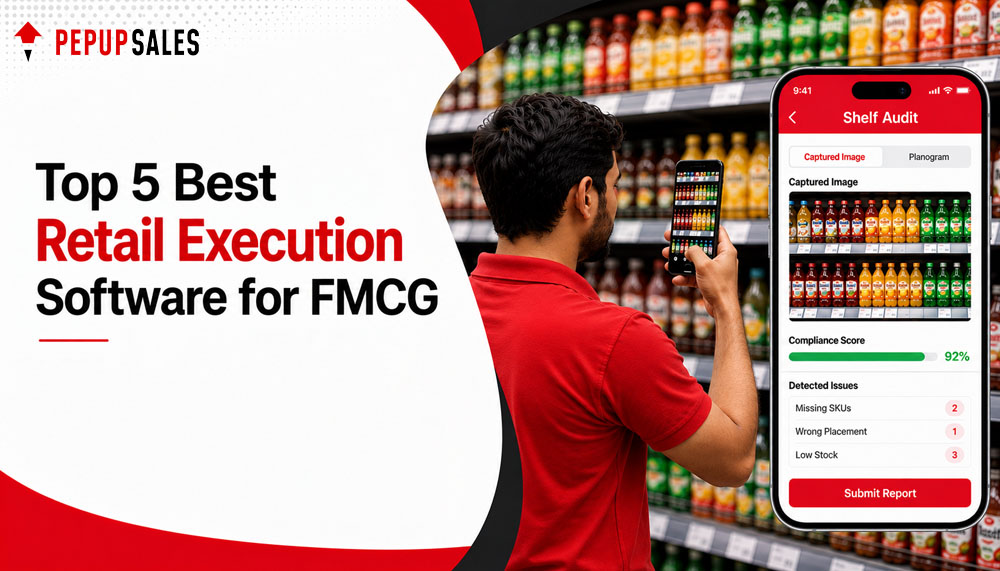
Retail execution has become one of the biggest growth drivers for FMCG and CPG brands. Even the best products and strongest distribution strategies fall short when execution breaks down at the last mile. Poor shelf availability, missed store visits, inconsistent merchandising, and limited field visibility can quietly impact sales and market share.
This is why Retail Execution Software has become an essential investment rather than an optional tool. The right platform connects your field sales teams, distributors, retailers, and merchandising activities on a single system, giving you real-time visibility into execution, primary, secondary and tertiary sales, and market performance. It helps brands respond faster, improve on-shelf availability, and execute every retail strategy with confidence.
In this guide, we’ve reviewed the top retail execution and retail audit platforms for FMCG in 2026. We compare their strengths, key features, and ideal use cases to help you choose the right solution for your business.
Best 5 Retail Execution Software for FMCG
1. PepUpSales — Best Retail Execution Software for FMCG
PepUpSales is an AI-powered Route-to-Market (RTM) platform that helps businesses streamline sales and distribution operations through a single connected ecosystem. It connects field teams, distributors, retailers, and market execution, providing complete visibility, stronger collaboration, and faster decision-making across the entire route-to-market.
The platform combines Sales Force Automation (SFA), Distributor Management System (DMS), Retail Execution, Retailer App, Van Sales, Visual Merchandising, Loyalty Management, and AI-powered Analytics into one unified solution, eliminating the need for multiple disconnected systems.
The platform is trusted by 1000+ brands across more than 15+ countries, spanning FMCG, CPG, pharma, and retail industries. It integrates smoothly with ERP systems like SAP, Oracle, Tally, and Zoho, so brands do not need to rip out their existing tech stack to adopt it.
Best for: FMCG, CPG, and pharma brands that want a single, unified platform for field sales, distribution, and retail execution, without heavy customization costs or long deployment timelines.
Where PepUpSales stands out:
- Unified SFA and DMS architecture: Field sales and distributor data live on one platform, so secondary sales visibility is available instantly instead of at the end of the day.
- AI-powered insights: The platform surfaces beat-level gaps, top-performing SKUs, and missed opportunities, helping teams act before revenue is lost.
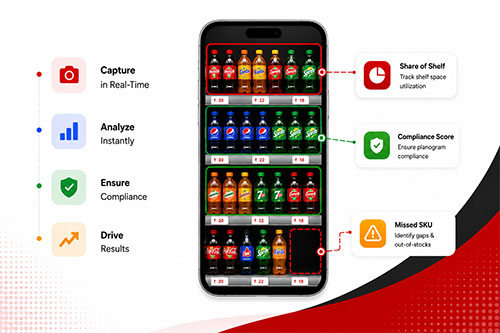
- Visual merchandising with scoring: Photos captured during outlet visits are geo-tagged and scored against brand compliance guidelines, not just stored as images.
- Beat planning and route optimization: Reps get optimized routes based on location, outlet potential, and rep familiarity, reducing travel time and increasing outlet coverage.
- Built-in BI dashboards: Leadership gets real-time performance tracking and automated reporting without waiting on manual reports.
- High customer satisfaction on scalability: Customers consistently highlight how well the platform adapts to their customizations, whether they run a 10-member team or a 1,000-plus field force.
- Multi-industry flexibility: While built for FMCG, the platform also supports automotive, pharma, and consumer durable businesses with similar route-to-market needs.
If your team is currently juggling separate tools for sales tracking, distributor orders, and merchandising audits, PepUpSales retail execution app is worth evaluating first. It is built to remove that fragmentation from day one.
2. Salesforce
Built on the broader Salesforce CRM ecosystem, Consumer Goods Cloud extends CRM capabilities into retail execution and field sales. It suits enterprises that have already standardized on Salesforce and want to connect retail operations with existing customer data and workflows. Features like account planning, retail visit management, and order capture all sit on top of the familiar Salesforce interface, which can shorten the learning curve for teams already using it for other functions.
The tradeoff is that it often needs deeper Salesforce investment to unlock its full potential. Many FMCG-specific workflows, such as complex trade schemes or multi-tier distributor hierarchies, require custom development rather than out-of-the-box configuration.
3. Repsly
Repsly focuses specifically on retail merchandising and field team management. It supports store audits, image capture, activity tracking, and merchandising analytics. Brands that need strong in-store merchandising visibility, without needing a full distributor management layer, often consider Repsly. Field reps can log shelf conditions, promotional compliance, and competitor activity directly from their phones. And managers get a clear view of execution quality across outlets.
Where Repsly tends to fall short for FMCG brands is on the distribution side. It does not offer the depth of secondary sales tracking or distributor stock visibility that a combined SFA and DMS platform provides. Brands that only need merchandising audits find it useful. But those managing a full route-to-market operation usually need to pair it with another system or look at a more integrated platform instead.
4. Botree Software
Botree has been in the DMS and SFA space for many years and serves a large base of blue-chip FMCG customers. Its strength lies in distribution management, including product, pricing, and scheme control, along with route optimization and gamified KPIs for field teams.
Botree is a solid choice for large distribution networks that need tight control over inventory and orders. However, some users note that certain processes can feel slower compared to newer, cloud-native platforms, and syncing across large datasets sometimes takes longer than expected.
5. BeatRoute
BeatRoute positions itself as a sales platform, combining SFA, DMS, and a retailer app with a suite of AI agents. It focuses heavily on turning field data into action. It includes recommending the next best order or flagging execution gaps as they happen, rather than only reporting on what already occurred. Beatroute serves FMCG, building materials, agri-inputs, and several other verticals.
This action-first approach makes BeatRoute appealing to smaller brands. That said, the platform is a newer entrant compared to some legacy DMS providers, so brands with very large or highly customized distribution networks should rethink how well its configuration options match their existing processes before committing.
Quick Comparison Table
| Platform | Core Strength | Best Suited For | Key Differentiator |
| PepUpSales | Unified SFA, DMS, and retail execution with AI-powered insights | FMCG, CPG, and pharma brands wanting one connected platform | Deep real-time integration between SFA and DMS, plus strong customization support |
| Salesforce | CRM-first retail execution | Enterprises already using Salesforce | Native integration with the Salesforce ecosystem |
| Repsly | Merchandising and field audits | Brands focused on in-store merchandising visibility | Strong photo-based audit and tracking tools |
| Botree | Distribution management and SFA | Large distributor networks needing tight inventory control | Two decades of DMS-focused product depth |
| BeatRoute | Goal-driven execution with AI agents | Brands wanting AI-guided next-best actions in the field | Suite of task-specific AI agents tied to sales goals |

Final Thoughts
Choosing a retail execution platform is not just about selecting software with the longest feature list. It’s about finding a solution your field teams will actually use every day, one that gives leadership real-time visibility, streamlines sales and distribution operations, and adapts as your business grows.
If you’re looking for a platform that brings together Sales Force Automation (SFA), Distributor Management (DMS), and retail execution in a single, unified solution, PepUpSales is built to do exactly that. It helps businesses improve field execution, strengthen distributor collaboration, and gain complete visibility across their sales and distribution network.
Book a free demo to see how PepUpSales can support your route-to-market strategy and address your unique business requirements.
Frequently Asked Questions
1. What is retail execution software?
Retail execution software is a digital platform that helps FMCG and CPG brands manage what happens at the retail shelf. It covers outlet visits, order booking, planogram compliance, and secondary sales and tertiary sales tracking, giving brands real-time visibility from the distributor down to the shelf.
2. Which is the best retail execution software in India?
PepUpSales is the best retail execution software in India for businesses looking to unify Sales Force Automation (SFA), Distributor Management (DMS), and Retail Execution on a single platform. With AI-powered automation, real-time visibility, and end-to-end sales and distribution management, it helps brands improve field execution, distributor collaboration, and retail performance at scale.
3. How is the retail execution system different from a regular SFA tool?
A standard SFA tool usually focuses only on field sales activities, such as order booking and visit tracking. Retail execution system goes further by including distributor management, merchandising audits, and shelf compliance, giving a fuller picture of the entire route-to-market journey.
4. Why do FMCG brands need both SFA and DMS in one platform?
When SFA and DMS run as separate systems, secondary sales data often arrives late or does not match what is happening in the field. Combining both on one platform means orders, stock, and field activity update in real time. It helps brands avoid stockouts and lost sales.
5. Is PepUpSales suitable for both small and large FMCG teams?
Yes. PepUpSales is used by brands with small field teams as well as those managing over a thousand reps across multiple countries. Its scalability and customization options are among the most frequently mentioned strengths by customers.
6. What features should a business prioritize when choosing a retail execution platform?
Look for real-time secondary sales visibility, beat planning, visual merchandising with compliance scoring, offline support for low-connectivity areas, and easy integration with your existing ERP system. AI-driven insights are also becoming a standard expectation rather than an extra feature.


