
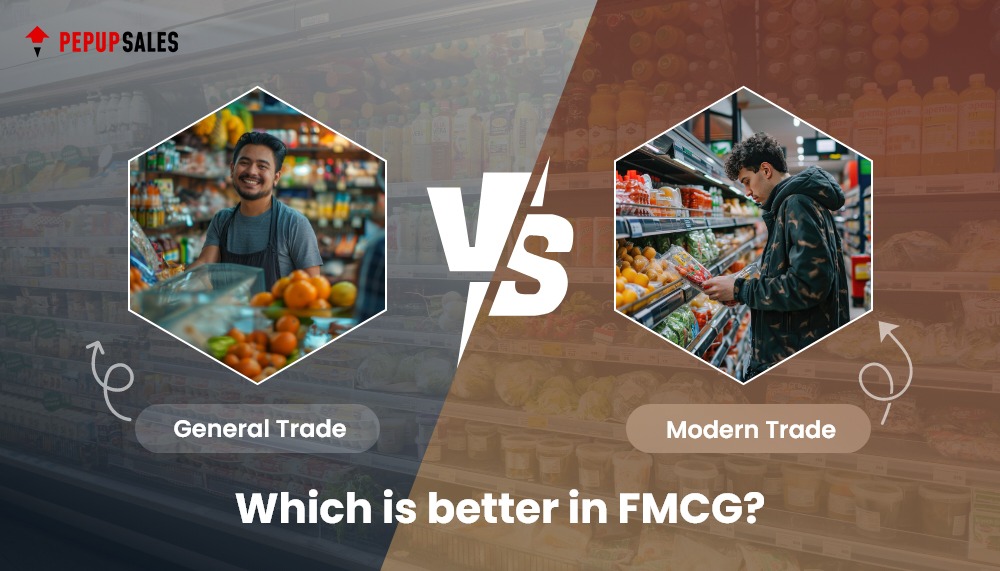
Trade is the fundamental economic activity of buying and selling goods and services between sellers and buyers. The FMCG sector has undergone significant transformation in recent years, primarily due to the emergence of modern trade channels.
Modern trade includes eCommerce platforms and organized retail outlets that focus on expanding market reach, improving customer service, building effective communication channels, and enhancing product visibility. These channels utilize technology and structured operations to deliver a better shopping experience for consumers.
General trade, in contrast, relies on traditional distribution channels to reach consumers. It comprises small kirana stores, local shops, and independent retailers typically operated by individual owners. Despite its unorganized nature, general trade holds over 80% of the market share, making it a crucial distribution channel for FMCG companies. While general trade lacks systematic organisation, it presents significant opportunities for companies to expand their business by strengthening distribution networks and addressing operational inefficiencies.
Two types: Modern Trade and General Trade
What is a General Trade?
It is the oldest form of selling products in the market in a traditional way. It mainly consists of local shops, standalone stores, and roadside stalls, that don’t have any solid infrastructure and are operated by single owners. So, it is also called an unorganized market. It holds most of the market, so it is crucial to grab the opportunity to expand the business for big FMCG firms.
Advantages of General Trade in FMCG
- General trade is traditional therefore no organized way of selling products in the market. With the right analysis and deeper penetration big FMCG brands will be able to reach more customers who live in remote villages, and tier-3 & tier-4 cities where modern trade is not operational.
- General trade holds more than 80% of the market share, which enables the big companies to fully control the customer’s needs and sell their products in general trade stores via a well-organized distribution channel.
- General trade stores like Kirana stores have a huge local customer base which enables more sales in rural areas. With the right approach, small retail stores can elevate sales profits.
What is a Modern Trade?
It is the new form of trade purely adopted from the urban phenomenon that became popular between the 1990s and early 2000s. Modern trade channels are the most efficient and well-organized form of trade for FMCG companies. It is operated by a group of people and stakeholders involving middlemen as sales reps and distributors for smooth operations.
Advantages of Modern Trade in FMCG
- Modern trade has a well-organized sales structure that enables the brands to sell their product on a larger scale. There is a small chain involved by eliminating the role of sales reps making the whole process efficient and productive with the retail stores like supermart and hypermarts.
- SFA enables the big brands to audit and examine their productivity directly with the retail stores without visiting them. Enabling more profits on sales and less time-consuming.
- Modern trade stores are spacious and accommodate more products on shelves than general trade making them more reliable to sell products in bulk. This is also a great opportunity for big brands to do visual merchandising in retail stores to attract more customers.
Challenges faced in Modern Trade vs General Trade
- Limited infrastructure: General trade stores do not have large infrastructure like Modern trade stores, which is a key disadvantage for major companies to sell their products on a bulk basis. Also, these shops have little shelf space and poor storage facilities, which limit the range and quantity of goods which they can stock at a given time.
- Low penetration: General trade has already covered the smallest neighbourhoods, rural areas and small towns, which is a disadvantage to the modern trade since supermarkets and hypermarkets are not everywhere but only in the best cities and exclusive places. This results in poor penetration among large organisations even though they have large infrastructures and resources as well as popularity.
- Inventory management complexities: General trade has a serious problem with the level of stock because of the inconsistent ordering patterns and the small storage capacity. Small retailers are not very much able to manage overstocking or stockouts that in turn affect the performance in sales. Modern trade, though with improved inventory systems, has difficulty in coordinating the stock at various locations of the stores and the complexity of centralised warehousing.
- Credit and payment terms: General trade is a very credit-dependent business in which retailers demand very long payment terms from the distributors. This poses a problem to the cash flow of FMCG businesses and exposes them to the risk of bad debts. Contemporary trade, on the other hand, can be very strict in terms of payment terms and discounts in promoting and listing fees, which can be very severe on profit margins of manufacturers.
- Data visibility and reporting: General trade has a bad data collection system, and therefore it is not easy to trace the performance of the sales of a company, consumer behaviour and, at the same time, predict the demand accurately. Brands would not get access to important insights that can make strategic decisions without proper digital tools. The availability of modern trade offers more data analytics, yet the problem is to combine the data with the general business intelligence systems to generate actionable information.
- Quality control and product display: When it comes to general trade, the products are usually kept in conditions that are not very favourable; hence, the quality is compromised and their shelf life is destroyed. The absence of correct merchandising standards also influences the visibility of products and their attractiveness to customers. The contemporary trade shops have improved standards yet experience difficulties in the regularity of positioning and exhibition of products in all the outlets, particularly during seasons or promotions.
Effective Sales Growth in Modern Trade and General Trade
All of it leads to the point where a business’s profit is determined by its sales. Only when the product is well-made, effective, and long-lasting is; it feasible for the customers. A few challenges have already been covered. For countermeasures to increase sales in both modern and general trade, refer to this section:
- Automatic order collection: It is one of the important phases in the sales process. Regular re-stocking helps you build a huge customer base. Pepupsales SFA plays a vital role in managing and giving the statistics of orders inventory, total orders left, and restocking needed on customer’s demand.
- Supply chain management: Compared with modern trade, general trade establishments have less organized and sophisticated inventory management and collaborate with regional wholesalers only. Whereas, Modern trade has access to improved logistics because of its sophisticated technological and logistical skills.
- GPS tracking and beat management system: General trade offers better market reach than modern trade for product selling. The best way to crack the huge profits is by GPS tracking the sales reps and providing them with productive beat routes for better deals and sales numbers because general trade is available in every part of rural areas, small towns, and remote areas.
- Competitor analysis: Pepupsales SFA provides a solution to analyze and audit the competitors to take necessary counter-measures to sell the product in the market. General trade is a big opportunity for companies to expand their business and beat the competitors in small-town areas.
- Brand recognition: Get proper insights into the brand value and visual merchandising via influencers and gain more attractive sales growth on your product. Modern trade has advanced in recent few years and big brands capture the market by increasing their brand value.
Overall business growth in Modern Trade and General Trade
Choosing between “modern trade vs general trade” is very difficult. But it is also difficult to handle both modern and general trade simultaneously. For modern trade to grow, brands should collaborate with distributors, sales reps, and stakeholders. This ensures a smooth workflow, altogether resulting in better sales, efficient product placement in stores, well-stocked inventory, and competitive pricing.
Whereas, in general trade, the brand should leverage technology like pepupsales SFA to streamline the whole process. Manage and utilize the data provided by the software to target specific retail stores that have huge customer base and sell the product very fast. Constant feedback from retail stores via sales reps increases customer satisfaction as well.
Key Implementation Points with Pepupsales SFA:
- Increase product quality and competitive pricing: With the Pepupsales SFA ensures that the customers buy the product more often and suggest necessary countermeasures like enhancement of the product quality with the right price on the market.
- Sales Field Automation: Pepupsales SFA is a renowned SaaS company that provides solutions to companies. A user-friendly interface specially designed for the sales reps to perform better and coordinate with the retailers on a pre-assigned beat.
Conclusion:
There is no doubt in saying that modern trade has revolutionized the way of selling products to customers in the FMCG sector. The difference in “Modern trade vs General trade” highlights the uncommon trade practices, supply chain medium, and different strategies. Modern trade outlets have a profound impact on the development of the FMCG sector among both, it also offers new business opportunities for big brands to reach more potential customers across urban areas.
We can say that the modern sector has grown the businesses as compared to general trade, but there is so much potential in the general trade sector and a vast room to grow. Take a free demo of SFA tools provided by Pepupsales to help elevate sales to the next level.


