
Brands spend months planning. They build detailed merchandising calendars. They negotiate vendor funding carefully. They map promotions well in advance.
But here is the problem.
None of that planning matters if it doesn’t happen correctly in stores.
There is a silent and expensive gap sitting between your headquarters strategy and what actually happens on the store floor. This gap is called the retail execution gap. And it quietly drains anywhere between $10 million to $40 million every single year for large companies.
The scariest part? Most brands don’t even know it’s happening.
What Is the Retail Execution Gap?
The retail execution gap is the difference between what headquarters plans and what stores actually do. It’s not about one big mistake. Instead, it’s about hundreds of small failures happening every day across your store network.
Think about these common scenarios. A promotion launches two days late. A shelf display gets set up incorrectly. A store associate skips a task during a busy weekend shift. Another associate never receives the campaign briefing at all.
All of these problems appear small individually. However, when combined, in 300, 500, or 1,000 stores, these little holes begin to add up very quickly. They become lost sales, wasted vendor funds, and lost revenue opportunities. Consequently, the initial step towards bridging this gap is to comprehend it.
A common way many retailers attempt to gauge execution is by determining whether instructions were dispatched. Sending of instructions is however not the same as actual performance. Store audits, use of mystery shoppers or photo verification usually horrifies the real compliance figures when retailers use them. The Headquarters takes 80-85 percent compliance. This is closer to 55-65%.
That is a 20-point difference between perception and reality.
Why Does This Gap Exist?
The retail execution gap doesn’t happen because store teams are lazy or careless. It happens because of broken systems. Three main issues drive poor execution across retail networks.
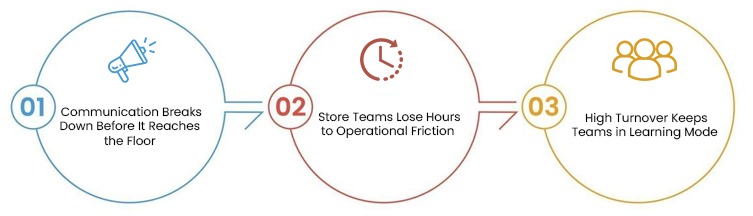
1. Communication Breaks Down Before It Reaches the Floor
Most retailers still rely heavily on email to talk to their store teams. The problem is that email open rates for frontline workers typically sit between 20–30%. Important instructions get buried. They get forwarded informally. They get printed and left in a back office.
As a result, the associate setting up a promotion may never read the instructions. They guess. They improvise. And your promotion goes live the wrong way.
Leading retailers are moving away from broadcast email. Instead, they use mobile-first tools with role-based messaging and read confirmations. This shift can improve communication engagement by up to 80%. Consequently, execution improves dramatically across stores.
2. Store Teams Lose Hours to Operational Friction
Every week the working time of frontline employees is lost 15-25%. They use this time to seek information, seek clarification or even rectify errors. This resistance does not merely waste time. It also saves time for your team in front of customers.
This type of friction cost the business an estimated 28 million per annum in lost productivity in one large convenience retail network. It was not a matter of employee performance. It was old systems of operation that were not designed to meet contemporary retail.
In addition, associates become demotivated when they feel lost or unhelped. This has the ripple effect of the entire chain of stores that you have.
3. High Turnover Keeps Teams in Learning Mode
The retail industry is one of the most volatile industries. The turnover is 40-70 per cent every year in many sectors. That figure is frequently over 80 in convenience retail.
New associates normally require between 6-10 weeks to be fully productive. They work at a level of approximately 60-70 percent in the time period. In high-turnover environments, then, a big portion of your workforce is constantly in the process of learning.
It implies that the quality of execution is constantly changing. Moreover, the stores that have a higher number of new employees will be prone to errors. The better news is that the more training and communication tools assist in accelerating the ramping up process of new associates. The studies indicate that informed and supported employees are 25-40 more likely to remain past the critical 90-day point.
What Happens When You Fix Execution?
The interesting side of this story is here. With the help of Retail Intelligence Platform, educing the retail execution gap is not only about cessation of losses. It is also a huge revenue prospect.
Take the example of a retailer of 1,900 stores whose revenues per store was in the form of 1.2 million a year. When the promotional compliance increases by 10 (60 to 75) the outcome is great. A 0.5% increase in the execution performance has the potential of producing 11.4 million incremental revenue. No new stores needed. No new products. Only improved implementation of the current plan.
Also, training is significant. Convenience, foodservice and specialty retailing In foodservice, specialty retailing, and convenience, well-trained associates are two to three times more effective than untrained associates. In thousands of daily customer contacts, such a difference generates a significant margin opportunity.
Thus, the enhancement of implementation does not only save money. It is dynamic in expanding your business.
How Are Smart Retailers Closing the Gap?
Leading retailers are not waiting for store visits to discover execution problems. Instead, they are building systems that connect headquarters strategy directly to frontline teams.
These Retail Intelligence Systems typically include:
- Mobile-first communication so associates get the right message at the right time
- Real-time task management to ensure every store completes the right tasks
- Photo and visual verification to confirm execution without manual audits
- Structured onboarding tools to get new hires productive faster
- Data dashboards for district managers to spot problems quickly
Moreover, AI is also beginning to make a contribution in this area. Artificial intelligence can be used to identify the stores that are likely to miss a promotion deadline. They are able to put tasks in priority to store managers. They are able to bring issues with execution to a whole network in real time. This assists managers to make superior decisions on a daily basis.
How to Start Measuring Your Own Execution Gap
Unless you measure the store execution, you are not aware of the size of your gap. The majority of the retail leaders overestimate compliance due to the fact that they only monitor the delivery of instructions.
In order to have a real picture, begin with:
Step 1: Conduct organized store audits by use of photo checking or mystery shoppers. Compare the findings with that which was anticipated by the headquarters.
Step 2: Question your store managers. Ask them what they could not understand about instructions, what they were able to overlook, and where they have no support.
Step 3: Review your vendor compliance reports. Do you always receive punishment as a result of non-compliance? A good indicator of it is an execution gap.
Step 4: Measure new associate ramp time. In case new employees require over 6 weeks to achieve full productivity, your onboarding program requires improvements.
After knowing the size of your gap then you can begin closing it. And even slight advances multiply soon in the form of a big network of stores.

Closing the Gap with the Best Retail Intelligence Platform
The retail execution gap is not a people problem. It is a systems problem. Store teams want to do their jobs well. But they need clear communication, simple tools, and real-time support to make that happen.
This is exactly where PepUpSales helps retail businesses get ahead. PepUpSales gives field teams and store managers a smarter way to track tasks, verify execution, and report back to headquarters in real time. As a result, brands can move from reactive problem-solving to proactive execution management.
The dollars lost to execution gaps don’t have to be permanent. With the right visibility and the right tools, they can become measurable gains in revenue, productivity, and customer satisfaction.
In today’s competitive retail environment, the brands that win are not always the ones with the best products or the biggest marketing budgets. Often, they are simply the ones that execute better.
Start measuring your execution gap today. Because what you can’t see, you can’t fix.