
You could have the best product in the category. But if it is hiding behind a competitor’s stack, shoppers will never find it. That is the silent problem share of shelf solves.
For FMCG brands, winning at the point of sale is not just about pricing or promotions. It starts with how much physical space your brand commands on the shelf. What is meant by the term share of shelf, why it’s important, how to determine it and what it really means in terms of what happens on the ground.
What is Share of Shelf?
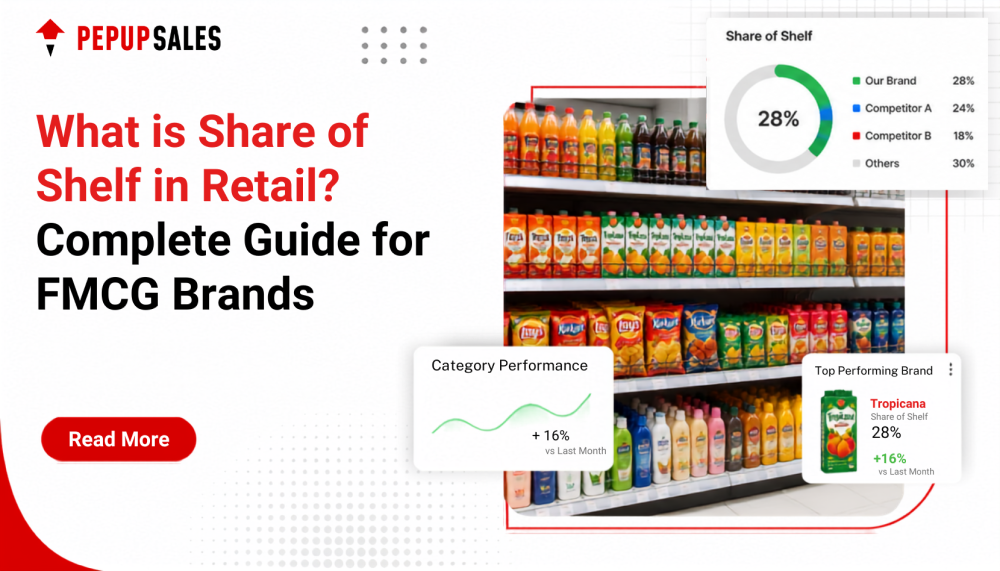
Share of shelf (SOS) is the percentage of shelf space your brand occupies within a specific product category in a store. It is a measure of visibility. It will tell you just how much physical presence your brand has in the moment your shopper is making their choice.
Simple example: If your biscuit brand has 3 facings out of 15 total facings in the snacks aisle, your share of shelf is 20%.
While there is a strong relationship between SOS and market share, they are not synonymous. Market share indicates what has already sold. Share of shelf is a measure of visibility prior to the purchase decision. Treat SOS as a ‘leading indicator’. When you make your presence on a shelf a good one, your market share follows.
Why Does Share of Shelf Matter for FMCG Brands?
With all the hustle and bustle in the retail world, things compete for attention and then for wallets. Your customer takes a few seconds to decide on a purchase. The brand that occupies more space is the brand that will be seen first.
The majority of the points earned from a good share of shelf are genuine business results:
- Increased brand recall and brand recognition at point of purchase.
- Better conversion rates as users are exposed to your product quicker
- Greater negotiating power with retailers and distributors.Enhanced negotiating strength with retailers and distributors.
- Increased ROI from marketing as in-store visibility enhances it
SOS isn’t only a strategic metric for field sales teams. It is a target that needs to be addressed by each rep at each outlet visit.
What factors impact your share of the shelf?
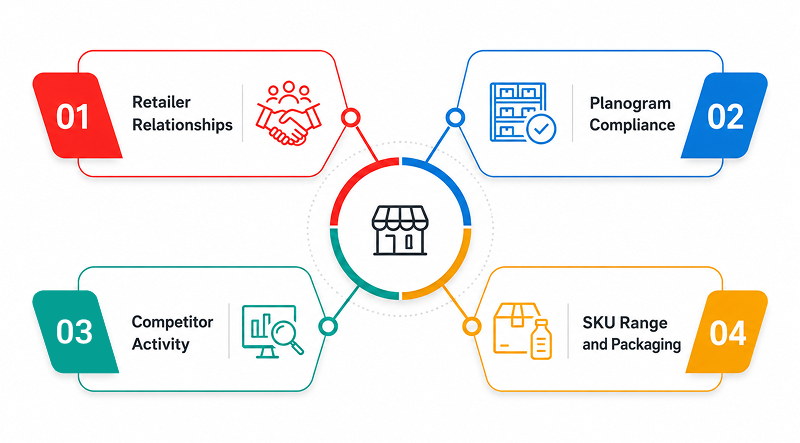
The first step is to understand SOS. To improve it, you need to understand what is causing it to do so.
1. Retailer Relationships
Shelf space is not awarded, it is negotiated. Space allocation depends on sales velocity, trade margins and relationship. Brands with clean data and sound sales arguments will be embraced more.
2. Planogram Compliance
You may have an agreement with a retailer about shelf space. However, it is only when your field reps and merchandisers are able to implement those planograms consistently, that what ultimately gets onto the shelf. When the deal is in place, but compliance is poor, then SOS will be lower.
3. Competitor Activity
All participants are always bidding for space. The share of a new product introduction or a good trade promotion by another brand can take a bite out of your share. This is an issue that can be identified early by regular audits.
4. SKU Range and Packaging.
With more SKUs comes more facings, if managed properly. But, bold and memorable packaging does much of the heavy lifting too, so your brand block is visible even in a small space.
How FMCG Brands REALLY increase Share of Shelf
Just knowing your SOS number is not sufficient. The actual work is in the doing.
Developing a Data-Driven case for Retailers
Your reps should be armed with evidence when entering negotiations. Clean, outlet level SOS data will create the confidence to request more space. A better discussion than requesting more shelves is to demonstrate to a retailer how your SKUs are performing compared to the category average.
Implement Planogram Outlet By Outlet
A planogram is only of value if it is carried out on the ground. Many brands design their shelves at HQ and then have no control of how they are done in the field. The solution is a retail audit framework that involves reps checking actual placement against the planned layout on each visit.
Deploy Merchandisers Strategically
Not all outlets are equal. Look at your sales information to prioritize outlets where the SOS is having the biggest impact on your sales. Send your merchandisers to these stores first. Each merchandising visit must have a definite goal that is directly related to a specific SOS improvement.
Make the most of POSM and Shelf Talkers Smartly.
Where more truly linear space is not always available, use the space you have more intensively! Shelf talkers, price labels and branded displays help to increase brand visibility even in a small space.
Monitor with Technology
Manual shelf audits are not scalable. Without the proper tools, a field rep visiting 15 outlets a day has no way of accurately counting facings, cross-checking planograms and flagging gaps. This is where SFA software with inbuilt retail audit features really comes into its own.
For example, PepUpSales allows field teams to gather shelf data, conduct outlet audits and monitor SOS trends throughout the distribution network. Rather than simply speculating where your shelves are low, your staff will be able to see what’s really happening in each store.
Common Share of Shelf Mistakes FMCG Brands Make
This is a mistake even big FMCG companies make. Here are the most common gaps:
Only measuring SOS at key accounts: Your top 50 outlets look great! However, for the 5,000 general trade stores, what about them? Most of the battles won or lost in SOS games happen there.
Think SOS in terms of quarterly measurement: Shelf changes weekly. Your share can change overnight due to a competitor promo, stock out or a new SKU being listed. You should have continuous visibility, not a snap shot.
Prioritising quantity over placement: 5 facings at the bottom shelf might not be as useful as 2 facings at eye level. Quality is as important as quantity of placements.
Failure to link SOS measures to field rep KPIs: If your reps aren’t tracked on their performance of shelf compliance and improving SOS, it remains a low priority on their list. Include it in their execution scorecard.

Final Thoughts
The link between your brand’s distribution and actual shopper conversion is the share of shelf. It’s possible to have a strong distribution, fantastic pricing and a solid trade marketing budget! However, if your product is not on the shelf, all that counts is nothing.
SOS needs to be an every day execution measurement, not a strategic slide in a quarterly review for all FMCG brands seeking growth. Each rep visit can be a chance to gain additional shelf presence, one outlet at a time, if the tools and field processes are utilized properly.
PepUpSales helps FMCG and distribution businesses track shelf execution, run retail audits, and improve field rep performance across every outlet in their network. If your team is still tracking SOS on spreadsheets, it is time for a better system.
Schedule a free demo with PepUpSales today and take your retail merchandising strategy to the next level!
Frequently Asked Questions
1. What is share of shelf in simple terms?
Share of shelf is the percentage of the shelf space your brand takes up in your particular store’s category. It is a measure of the visibility of your brand when a shopper is making a purchase decision.
2. How is the share of shelf different from market share?
Market share is an indicator of what’s already been sold. Share of shelf is the product of visibility prior to purchase. SOS is a red flag warning. Make it better, see Market share does tend to improve too.
3. How do FMCG brands measure SOS at scale?
A retail audit software that uses image recognition technology is the most viable solution. A rep takes a picture of the shelves and the system automatically computes the linear SOS, facings, and eye-level presence.
4. Why is eye level placement significant in SOS?
Shoppers pay the most attention to eye level shelves. Facing at eye level has a higher conversion rate than the bottom or top shelf. The smaller the SOS at eye level the better it will be compared to a larger SOS placed below the waist.


