
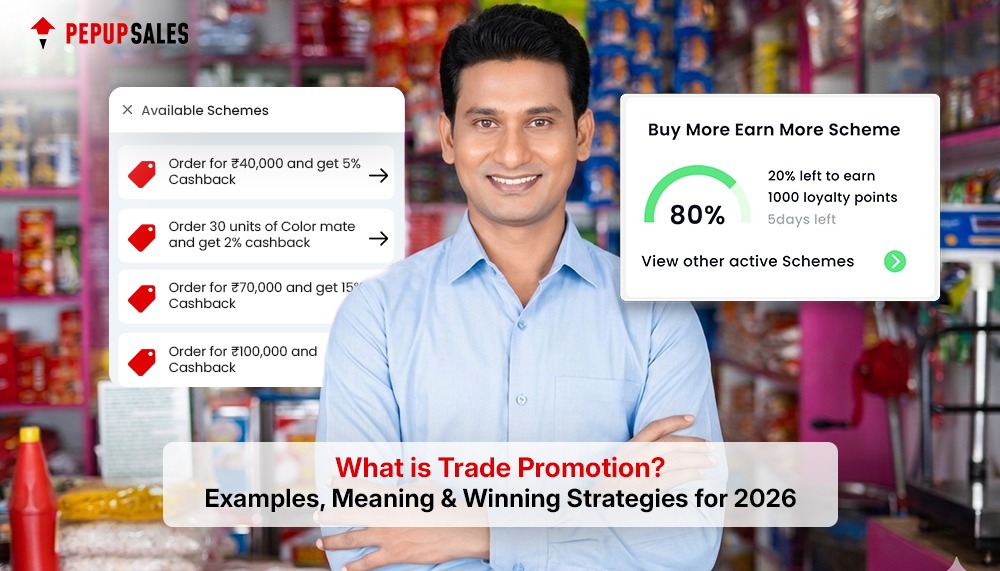
In the world of retail and FMCG, the battle for market share is not just fought on store shelves, it starts much earlier, in the relationships brands build with their retail partners. Getting a retailer to stock your product, give it prime shelf space, and actively promote it to customers requires more than just a good product. It requires strategy. And that strategy often begins with trade promotions.
Trade promotions are a critical component of any brand’s go-to-market plan. According to industry estimates, consumer goods companies spend nearly 20% of their revenue on trade promotions every year. Yet, a significant portion of that spend delivers little to no measurable return, simply because brands lack the right planning, execution, and measurement framework.
In this blog, we cover the complete trade promotion meaning, key examples, the most effective types, and data-backed strategies to help your brand grow in 2026.
What is Trade Promotion?
Trade promotion is a marketing strategy where brands offer special incentives to retailers, distributors, or wholesalers. The goal is to encourage these partners to stock, display, or actively sell your products.
Think of it this way, you’re not selling directly to customers here. Instead, you’re motivating the people between you and the customer. These could be supermarkets, local kirana stores, pharmacies, or distributors.
Trade promotions can take many forms. They include price discounts, free goods, display allowances, cashback offers, and sales contests. All of these are designed to push your product further into the market and keep it visible on shelves.
Why Do Brands Use Trade Promotions?
Trade promotions serve a very clear purpose. They help brands grow their distribution network, increase sales volume, and build long-term relationships with retail partners.
Here are some key reasons why brands invest in trade promotions:
- Expand market reach: Get your product into more stores and regions.
- Increase shelf visibility: Win better shelf placement and display space.
- Drive volume during slow seasons: Move stock faster when sales dip.
- Launch new products: Give retailers a reason to try something new.
- Build loyalty with channel partners: Reward partners who consistently support your brand.
However, trade promotions only work when they are well-planned. Poorly designed promotions can eat into your margins. They can also confuse your retail partners. So, planning matters a lot.
Trade Promotion Examples You Should Know
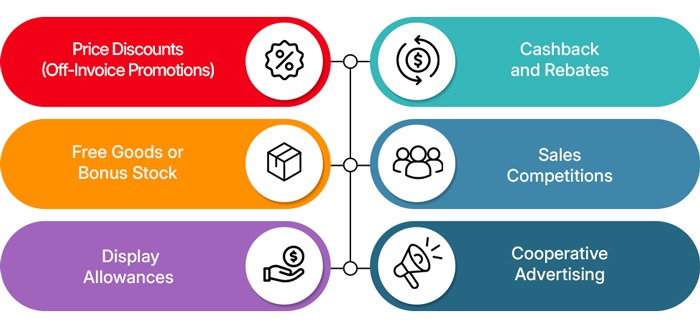
Let’s look at the most common trade promotion types used in 2026. Understanding these examples will help you decide which ones fit your brand best.
1. Price Discounts (Off-Invoice Promotions)
This is one of the most widely used trade promotion strategies. You provide retailers with a temporary discount of wholesale price. The retailers will be able to transfer the savings to final customers or to enhance their margins.
As an illustration, a soda brand can provide a 10 percent price reduction to the supermarkets during the summer holiday. This makes the retailers keep more units and market the product more vigorously.
2. Free Goods or Bonus Stock
In this case, brands can provide additional units at no expense conditioned on purchasing a specific number by retailers. One such example is the Buy 10 cases, get 1 free. This raises the average size of the order of the retailer. It also assists in making your product take more space on the shelf.
3. Display Allowances
The brands pay the retailers or provide them with incentives to develop special in-store displays. These may be shelf talkers, standees, end of cap displays or point of purchase (POP) units. Imagery displays attract customers to make purchases.
4. Cashback and Rebates
Under this form of promotion, retailers get cash back once they achieve some targets. In some cases, e.g. a brand may give a 5 percent rebate under the condition of 5 lakh rupees monthly sales by a retailer. This encourages the partners to strive more but not to reduce daily prices.
5. Sales Competitions
Contests are held between the sales teams or retail partners of brands to generate enthusiasm. The loser- the distributor or the store that sells the least number of units gets a prize or bonus to the winner. It is particularly effective in case of festive seasons or launching products.
6. Cooperative Advertising
Retailers share the local advertising cost with the brands. As an example, a brand may sponsor half a newspaper advertisement by a particular retailer who has their product in the advertisement. This endears itself to the locals and makes the brand more visible.
Trade Promotion vs Consumer Promotion: What’s the Difference?
Trade promotions are confused with consumer promotions among many people. Let’s clear this up quickly.
Trade promotions are aimed at intermediaries: retailers, distributors, and wholesalers. They are aimed at driving products across the supply chain.
Consumer promotions are aimed at the end customers. Imagine ‘buy one get one’, loyalty points or giving shoppers product samples.
These two kinds of promotions complement each other. However, they are used to serve different purposes in the sales funnel. An effective marketing plan takes advantage of both.
Winning Trade Promotion Strategies for 2026
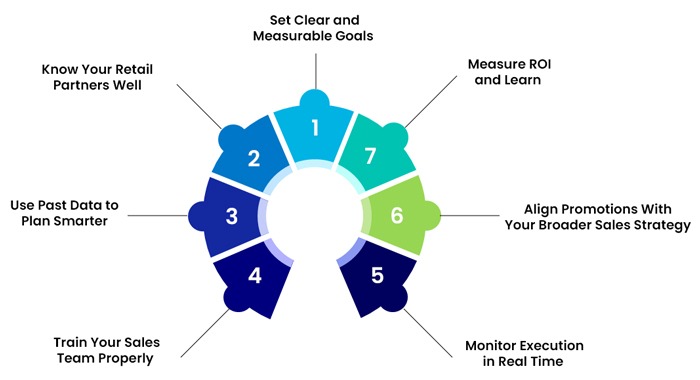
Running a trade promotion is easy. Running a successful one is harder. Here are the strategies that actually work in today’s competitive market.
1. Set Clear and Measurable Goals
Whatever you intend to accomplish, clarify it before any promotion is rolled out. Are you attempting to gain bulk? Enter a new geography? Clear old stock? Launch a new SKU?
Without certain ambitions, you can not gauge success. Furthermore, your field sales team will lack the idea on what to concentrate on. Always have certain time-limited goals with every promotion.
2. Know Your Retail Partners Well
Retailers are not all equal. The needs of a big supermarket chain do not match small local stores. As such, design promotions that are suitable to your partners.
Major contemporary trade partners might want to be offered volume-based rebates or co-op advertising. Smaller traditional trade partners, on the other hand, tend to react more readily to the free goods or show support. Promotions that are customized enhance participation levels and outcomes.
3. Use Past Data to Plan Smarter
A good trade promotion management begins with data. Review your past performance in promotions. What products were doing well? What areas were the most successful in sales lift? What is the time of the year where ROI is the best?
Historical data will also enable you to spend the budget of promoting your trade wisely. It also minimizes chances of investing in unproductive promotions.
4. Train Your Sales Team Properly
The trade promotion is through your field sales force. They are the ones who are communicating offers to retailers and make them comply. Unless they get the promotion in its entirety, implementation will be poor.
Train department on the promotion background, targets, and dealing with typical questions posed by retailers. An educated sales person makes more sales and establishes healthier relationships with retailers.
5. Monitor Execution in Real Time
Poor store level performance is one of the greatest problems in trade promotion. The reason why promotions fail is not necessarily due to poor design but rather is because the approach is not taken appropriately.
Use a trade promotion management tool to track:
- Whether promotional materials are placed correctly
- If the discounted pricing is active in stores
- Whether stock levels are sufficient
- If retailers are following the agreed planogram
Tools like PepUpSales help brands monitor field execution in real time. With mobile based sales force automation, your team can capture store-level data instantly. This means you can fix problems before they affect your results.
6. Align Promotions With Your Broader Sales Strategy
Trade promotions are not to be done in vacuity. They would need to foster your larger business interests. As an illustration, when venturing into a new region, your advertisement should first involve securing an attraction in the region.
Equally, in case of attempting to enhance the shelf placement of your product, combine promotion with a planogram push. This has the positive effect of making sure that even during the promotion period, your high-margin SKUs remain at eye level.
7. Measure ROI and Learn
When promoting, measure the results after each promotion. Incremental sales, incremental unit cost, and incremental unit margin calculations. Compare the results with your original objectives.
In addition to this, seek the opinion of your retail partners. Inquire of them what was effective and what was not. Take these lessons to enhance the next promotion. It is constant learning that creates a gap between average brands and market leaders.
Common Trade Promotion Mistakes to Avoid
Trade promotions are errors of even established brands. The following are some of the typical ones to be aware of:
- Carrying out too many promotions simultaneously: This causes confusion to retailers and hides the impact of promotions.
- The same promotion to all partners: As noted, various partners should be provided with different incentives.
- Lack of post-promotion analysis: This is one of the steps that many brands do not follow and end up making the same errors.
- The use of manual tracking: Manual reports and spreadsheets cause a delay in insights and cause errors.
These are some of the mistakes that you will want to avoid in planning your trade promotion.
How PepUpSales Helps You Win at Trade Promotions
Managing trade promotions manually is difficult. There are too many moving parts, multiple products, regions, partners, and targets. That’s where PepUpSales comes in.
PepUpSales is a sales force automation platform built for FMCG and retail brands. It helps your field team execute promotions correctly, capture store data in real time, and report outcomes accurately. With PepUpSales, your trade promotion management becomes faster, smarter, and more effective. From planning promotions to tracking compliance at the outlet level, PepUpSales gives you complete visibility over your trade spends and results.
If you want your trade promotions to deliver real, measurable results, it’s time to work smarter. Start with a clear strategy, use data to guide your decisions, and let PepUpSales handle the rest.

Conclusion
Trade promotions are one of the most powerful tools in a brand’s sales strategy. When managed and undertaken effectively, they push volume, establish and build retail relationships, and expand market share. However, they need definite objectives, intelligent planning, and stable implementation.
The winning brands in 2026 will be those that have a combination of a powerful promotional strategy and the appropriate technology. PepUpSales assists you in doing just that, in the sense of connecting the gap between the promotion planning and the real world implementation. Are you ready to bring your trade promotion management to the next level? Book a Free Demo now.