

Managing distributors is one of the hardest parts of running a growing business. Orders come from different places. Stock updates are delayed. Payments are tracked on calls and messages. Over time, this creates confusion and slows down growth.
This is where a Distributor Management Software helps. It brings distributors, sales teams, and management onto one system. Orders become clear. Stock stays visible. Decisions become easier. But choosing the right tool is not simple. Many software options look similar on the surface. Each one promises big results. Still, not every solution fits every business.
This guide explains how to select the best distributor management software in a practical way. It covers features, pricing, and comparison points that matter for Indian businesses. It also explains how PepUpSales helps brands manage distribution better and grow with control.
Understanding Distributor Management Software: The Foundation of Modern Distribution
A Distributor Management Software (DMS System) is far more than just software, it’s a strategic investment that transforms your entire distribution network. At its core, a DMS centralizes all distribution operations into a single platform. Everything from inventory management and order processing to billing, claims settlement, and performance analytics happens in one place.
Think about your daily challenges. Distributors calling about stock availability. Manual order entries leading to errors. Delayed claim settlements causing friction with partners. Lack of visibility into actual retail sales. A robust DMS addresses all these pain points systematically.
The numbers are compelling. According to Gartner, companies implementing DMS solutions report a 25% reduction in operational costs and a 30% improvement in order accuracy. These aren’t incremental improvements—they represent fundamental transformations in operations.
For small and mid-sized businesses, a DMS System for small and mid-sized businesses offers agility to compete with larger players. For enterprise companies, the Top distribution management Software for enterprise companies, provides robust infrastructure to manage thousands of distributors across diverse geographies.
key Features of Distributor Management Softwares
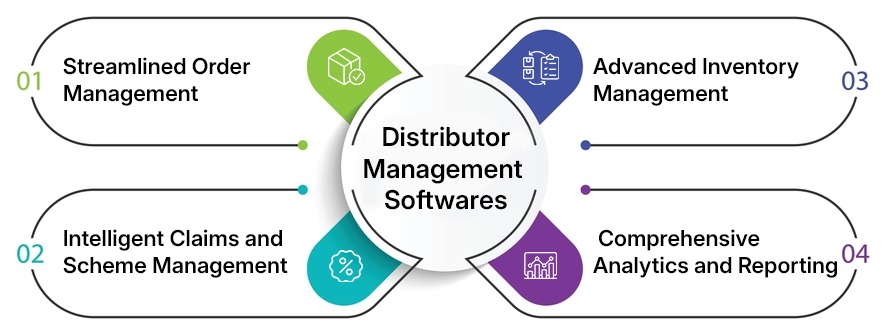
When evaluating how to select distribution software, you need to look beyond basic functionality. The best systems integrate multiple capabilities that work together seamlessly. Let’s explore the critical features that separate average software from exceptional solutions.
1. Streamlined Order Management
The B2B distribution management software nowadays is an automated system that takes the order-to-cash cycle. The distributors are supposed to make orders via various options and these include mobile apps, web portals or WhatsApp integration.
It is important to have real-time access to the stock as orders are being made. Distributors make quality decisions when they observe the present inventory levels. This saves back-orders and increases the fulfillment rates significantly.
Sales return protocols with pre-set threshold limits are integrated thus facilitating smooth take-up of returns. The system automatically checks the return requests with the policies which expedites the process and also deters abuse.
2. Intelligent Claims and Scheme Management
Many of the traditional systems fail in claims and scheme management. Handling claims manually may require weeks (or even months) to complete, which disappoints distributors and ruins relations. This is different with automated claim settlement.
Complex scheme structures are easily handled by the best systems. The software must be able to accommodate any combination of the above: volume-based prices, seasonal deals, or localized deals. It must be able to monitor the rates of scheme adoption in real-time, displaying you which promotions are yielding and which require modification.
More importantly, the use of sophisticated features must block fraudulent claims automatically. The reversal of claims and validation checks safeguard your margins and preserve the trust of your distributors. PepUpSales is designed with such protective measures, which are standard features that guarantee financial integrity in your distribution network.
3. Advanced Inventory Management
Inventory management is the backbone of distribution operations. You need real-time tracking that updates automatically as products move through your network. This means seeing exactly what’s in stock at each distributor location, what’s in transit, and what’s approaching expiry.
Smart DMS systems predict the trends in demand by using the past data, enabling you to keep the right level of stock. In case some of the products sell better in particular seasons, it warns you in advance. This avoids stockout in times of peak demands and decreases wasted inventory due to expired items.
PepUpSales goes a step higher with the smart alerts on expiring stock. These can be used as such, where you can initiate a special campaign to turn them into a sales opportunity. This is a saving that businesses make yearly.
4. Comprehensive Analytics and Reporting
Information that lacks insights is just noise. The Best distribution management software for FMCG will turn the raw data to actionable intelligence.
The visibility of secondary sales is especially significant to FMCG companies. Secondary sales (distributor to retailer) indicate actual performance in the market whereas primary sales (company to distributor) are simple to monitor. This information is automatically recorded through a strong DMS.
Distributor performance, product velocity, scheme effectiveness and trends in the market can be viewed at a glance using real time dashboards. Predictive analytics will assist you with deciding in advance what to expect in the future. When statistics indicate a low sales level at a particular region, you can start investigations right away- is there stock problem, competitor activities, or new tastes.
How to Select Distributor Management Software: A Step-by-Step Guide
The selection of the appropriate system must be planned. The mere comparison of lists of features will not provide you with the whole picture. The following is a detailed decision-making model.
Step 1: Conduct a Thorough Business Assessment
Begin by mapping your present distribution landscape. What is the number of your distributors? Where are they geographically dispersed? What do you consider as the biggest operational pain points?
Consider your growth plans. Scalability is important in case you intend to expand your network of distributors by twice within a span of two years. And the system you adopt nowadays must expand with you without a hitch.
Step 2: Evaluate Integration Ecosystem
Your DMS does not work in isolation. It must be able to integrate seamlessly with the existing systems. The program should be able to interface with your financial data ERP, customer information CRM and field operation SFA.
Immediate data synchronization removes redundancy of entries and minimizes errors. Ordering by a distributor should automatically change inventory, initiate warehouse duties and be included in financial statements.
PepUpSales is highly integrated with major ERP and CRM systems and will guarantee seamless distribution data transfer throughout your business environment.
Step 3: Prioritize User Experience and Adoption
This is a harsh reality, the most fully featured software is useless unless your distributors are going to make use of it. The experience of users directly influences the rates of adoption which ultimately determines ROI.
A significant challenge associated with the adoption in India is that distributors also deal with a variety of brands. They will not embrace implementation in case they require individual DMS to each brand. It is at this point that hybrid approaches come in handy.
It is also important that mobile access is available. There are a lot of distributors who work in small shops with no specific workstations. A mobile-first DMS will help them to control orders, stock check, and claims directly using their smartphones. Find offline solutions, which automatically sync with the Internet upon connecting again.
Step 4: Assess Vendor Capabilities and Support
The software is not more significant than its vendor. You are getting into a long-term relationship, not purchasing a product. Test vendors on other aspects other than software features.
Track record matters. What is the number of years the vendor has been in the market? What is the number of distributors that use their platform? Request case studies among the firms like yours. The success of implementation is usually based on the quality of customer support. Research indicates that two out of every three companies prioritize trusted customer service in choosing distribution software. What are the support structures of the vendor? Does it have support for regional languages? The speed of their response to problems?
Step 5: Understand Total Cost of Ownership
The price of distributor management software in India goes with features, size and deployment formulas. Sum up the overall ownership of the cost (TCO) which includes the license charges, implementation costs, training costs, maintenance, integration development and infrastructure.
Cost should however be considered in relation to value. A relatively higher priced solution having the ability to shorten the claim settlement time to 10 days instead of 60 days provides immeasurable value in terms of better relationship and cash flows.
Step 6: Conduct Thorough Software Comparison
Develop a comparison system with hierarchy to analyze the deployment speed, flexibility of customization, scalability, mobile capabilities and security. How quickly can you go live? Is the system flexible to your processes? Does it scale in performance? Does it have everything on mobile? Is it up to industry standards of security?
Why PepUpSales is the Best Distributor Management Software in India
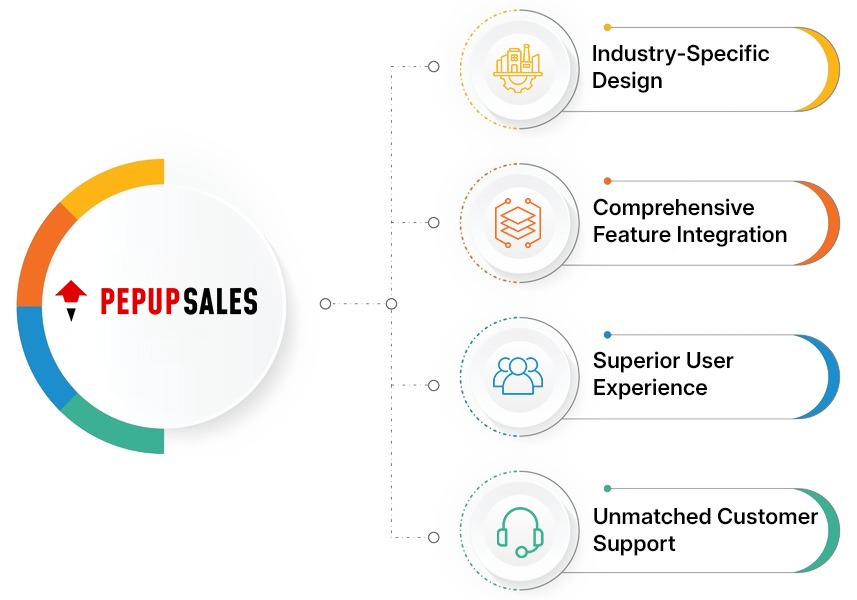
PepUpSales has become the preferred choice for businesses across India. Here’s why we stand out.
Industry-Specific Design
PepUpSales is built specifically for FMCG and consumer goods. This specialized focus means every feature addresses real distribution challenges. We handle geography-specific taxes, multi-tier pricing, complex promotions, and offline functionality—all the nuances that matter.
Comprehensive Feature Integration
PepUpSales provides a fully developed ecosystem. Inventory, automated orders, intelligent claims, advanced analytics, and retailer management are synchronized. Our scheme management deals with unlimited promotional combinations automatically.
Superior User Experience
We focus on adoption by way of superior UX. The mobile application is fully functional with little training required. In the case that distributors would rather not change their workflows, we provide Tally plugins. Such flexibility has a dramatic effect on adoption rates.
Unmatched Customer Support
In addition to software, PepUpSales is very supportive to the point of making it a success. We provide on ground training in India through various languages. It has 24/7 technical support, which makes it have minimal downtimes. The development is feedback-based, which means that the platform is developed according to the real needs of users.
Final Words
Choosing the best distributor management software in India is a strategic decision that shapes your distribution capabilities for years. The right system reduces costs, improves efficiency, strengthens distributor relationships, and positions you for sustainable growth.
PepUpSales combines comprehensive functionality with exceptional usability, backed by proven results across diverse businesses. Our platform is specifically designed for the Indian market, understanding the unique challenges of managing complex distribution networks across varied geographies and infrastructure levels. Ready to transform your distribution operations? Experience PepUpSales firsthand with a personalized demo. See how we can streamline your processes, improve distributor satisfaction, and drive measurable business growth. Talk to our experts today to schedule your free demo and take the first step toward distribution excellence.