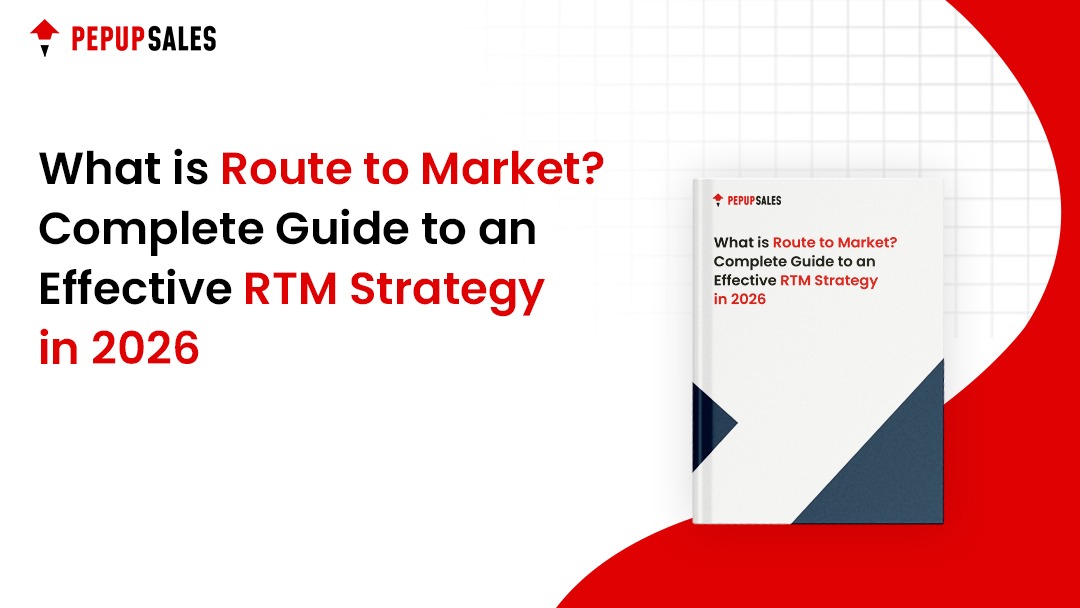
Route to Market, commonly called RTM, is the path a product takes from the manufacturer to the end customer. It defines who sells, who distributes, and how products reach every outlet, from large supermarkets to the smallest corner store. In simple terms, RTM answers one critical question: How do our products get to the right customers, at the right time, in the right quantity?
For FMCG and retail brands, RTM is far more than a logistics plan. It directly shapes sales speed, product availability, and how deep your brand penetrates a market. A well-planned RTM means your products are always on the shelf when a customer needs them. A poor one leads to stockouts, lost visibility, and inconsistent growth.
Since brands operate on thin margins and high volumes, even small gaps in execution can hurt daily sales numbers. That is why a strong RTM strategy always comes back to three things: reach, speed, and consistency.
Why Does RTM Strategy Rethink in 2026?
Markets in 2026 are more competitive than ever. Customers have more choices. Distribution costs are rising. And brands are under pressure to do more with less.
Simply having a good product is no longer enough. How you reach your customers is just as important as what you sell.
An effective Route to Market strategy helps you:
- Reach more outlets with the right products at the right time
- Reduce distribution costs through smarter planning
- Improve sales team performance with clear territories and goals
- Respond faster to market changes and competitor moves
- Build stronger relationships with distributors and retail partners
Moreover, brands that invest in RTM planning consistently outperform those that rely on ad-hoc distribution. The difference shows up in revenue, margins, and customer satisfaction.
Types of Route to Market Models
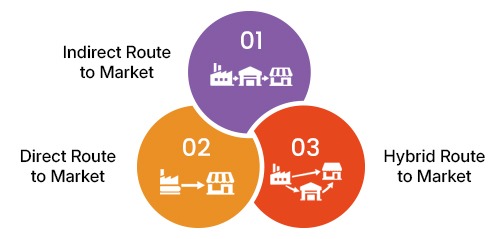
Choosing the right RTM model depends on your product type, market size, and business goals.
1. Direct Route to Market: Here, the brand sells directly to retailers or end customers. This gives maximum control over pricing, visibility, and customer relationships. However, it requires higher investment in sales teams and logistics.
2. Indirect Route to Market: In this model, the brand works through distributors or channel partners. They handle sales and delivery in their territory. This approach scales faster but gives you less direct control.
3. Hybrid Route to Market: Most successful brands use a combination of both. For example, they may go direct in key urban markets while using distributors in smaller towns. This is also called a multichannel route to market strategy.
Step by Step Guide to Building a Winning Route To Market Strategy
Now let’s get into the actual steps. Follow this process to build a strong, results-driven RTM plan.
Step 1: Conduct Market Analysis and Segmentation
Begin with the mapping of your total addressable region to create an effective Route to Market Strategy for FMCG business. Divide your consumers based on where they live, the type of outlet they shop in, their shopping habits, and channel. The categories of common outlets are pharmacy, institutions, convenience stores and grocery stores.
Categorize outlets in terms of value also, A, B and C stores, according to the sales potential. This will assist you in making priorities in what you put effort and resources into.
Find weak points: Where are you strong distribution wise? In what areas do you lack coverage? The insights inform all that transpires.
Step 2: Define Your Channel Strategy
Depending on how you have analyzed your market, then make decisions on the channels that would make sense to your brand. Ask yourself:
- What are the most efficient channels to my target customers?
- Am I economically empowered to do it directly or do I require partners?
- How much control must I have with pricing and shelf presence?
A hybrid strategy is most effective with most retail brands. Direct sales can be applied in the high-value regions, and indirect distribution is impractical due to the cost or geographical factors.
Step 3: Design Sales Territories
Proper design of the territory is not given much attention but it plays a very important role. Ill-constructed territories cause coverage holes within the territory, overworked representatives and a disagreement between the channel partners.
Establish balancing market potential and rep capacity territories. Bring geographic data to come up with definite boundaries. Ensure that all the reps are given responsive number of outlets to cover in a regular fashion.
Reviewing territories at least once a year. Markets evolve, and your territory design must be seen to that.
Step 4: Select and Manage Channel Partners
In case you are employing distributors or channel partners, you need to select them. Find partners with whom you are familiar with their product category, and they have good market relations and have the same values as you do.
Establish expectations at the onset. Establish performance goals, support programs and timetables of review. Good associations will have the effect of extending your reach without a commensurate expense.
Moreover, invest in your spouses. Coach their teams, disseminate market information, and make them triumphant. One of your greatest growth resources is a motivated distributor.
Step 5: Set Up Technology and Infrastructure
In 2026, RTM without technology is like driving without GPS. You need systems that give you real-time visibility into sales, inventory, and field activity.
Key tools to consider include:
- Sales Force Automation (SFA): Tracks rep activity, outlet visits, and order capture in the field
- Distributor Management System (DMS): Monitors primary and secondary sales, stock levels, and partner performance
- Route Planning Software: Optimizes beat plans to reduce travel time and cost
- Van Sales and Visual Merchandising Tools: Manage in-store execution and product visibility
PepUpSales offers a powerful platform that brings these capabilities together. It helps field sales teams work smarter, not harder, by giving them the right information at the right time.
Step 6: Train Your Team
The most effective strategy would not work without appropriate implementation. Pre-launch: Commission your in-house teams and your channel partners.
Ensure that each one of us knows the role, the targets and the available tools. Role specific training is better than generic training. A distributor manager should be trained differently as compared to a sales rep.
Also, don’t stop at launch. Continuous training and updating of the coaches helps to maintain high performance with the changing markets.
Step 7: Define KPIs and Track Performance
You cannot improve what you do not measure. Set clear KPIs that align with your RTM goals.
Common RTM metrics include:
- Numeric Distribution: Percentage of targeted outlets stocked
- Weighted Distribution: Distribution weighted by outlet sales contribution
- Outlet Productivity: Average sales per active outlet
- Lines per Call: Number of SKUs ordered per sales visit
- Cost per Sale: Total distribution cost divided by revenue
- Customer Satisfaction Score: How happy your retail partners are
Review these metrics regularly, weekly for operational KPIs, monthly for strategic ones. Use the data to spot problems early and make adjustments quickly.
Step 8: Review and Optimize Continuously
The construction of a Route to Market strategy cannot be performed once. There is movement of markets, competitors and customer needs.
Set up a regular review cycle. See what is going and what is not. Discuss with your field units and distribution associates. Exploit your technology tools data to determine trends and opportunities.
Living plans are the most effective RTM strategies; they are improved and changed as time goes by.
Common Route to Market Challenges (And How to Fix Them)
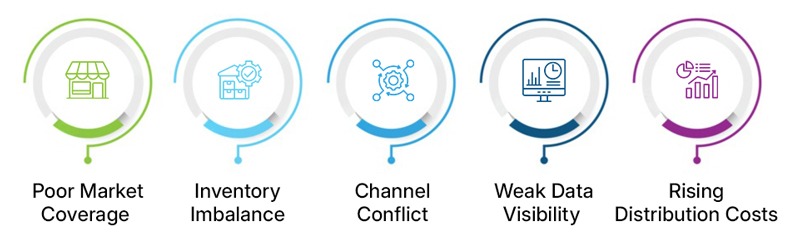
Even well-designed RTM strategies face obstacles. Here are the most common challenges and practical solutions.
Challenge 1: Poor Market Coverage
Most of the brands are well covered in the urban regions but poorly penetrated in the small towns and rural locations. This constrains the potential of growth.
Solution: Outlet universe mapping with identification of under served areas. Get into expansion that depends on the potential revenue rather than distance. Think about having sub-distributors in more difficult to reach markets.
Challenge 2: Inventory Imbalance
A frequent sore issue is stockouts at the high-demand stores and surplus inventory at the slow moving ones. This issue is aggravated when there are multi-tier distribution networks.
Solution: Adopt GPS-based tracking systems and inventory. Historical sales information can be used to establish smarter replenishment triggers. Order recommendations based on AI have the potential of reducing stockouts by a large percentage.
Challenge 3: Channel Conflict
Competition between different channels on the same consumers will cause a strain on pricing and a relationship of mistrust between partners. As an example, a distributor can be competing with your direct sales team in the same area.
Solution: Establish clear roles in channels and boundaries of territory. Apply performance rewards that are based on teamwork. Ensure every channel has its purpose and customers.
Challenge 4: Weak Data Visibility
There are numerous brands that cannot even imagine what goes on in the secondary sales level. Without this information, one would hardly be able to see issues or make decisions.
Solution: Implement a Distributor Management System which will record real time secondary sales. Integrate it with field sales applications data to obtain a complete image of your RTM health.
Challenge 5: Rising Distribution Costs
Distribution costs can easily spiral as fuel prices, labor costs and the complexity of logistics is on the rise. This reflects on squeezing margins and restricting investment in growth.
Solution: Rendezvous solution to enhance beat efficiency is through solution optimization software. Minimize unproductive visits and maximize strike rate (productive calls to total calls). Even minor gains in efficiency will translate into huge savings in the long-term.
Conclusion
A well-designed Route to Market strategy is one of the most powerful drivers of business growth. It aligns your sales team, distribution network, and technology behind a clear, shared goal, getting the right products to the right customers, efficiently and profitably.
In 2026, brands that invest in smart RTM planning will outperform those that rely on outdated or informal distribution approaches. The key is to start with a solid market understanding, choose the right channels, empower your field teams, and use data to continuously improve.
If you are looking for a technology partner to power your RTM strategy, PepUpSales is built exactly for this. From field sales automation to distributor management and outlet analytics, PepUpSales gives your team everything they need to execute your RTM strategy with confidence.
Ready to transform your Route to Market? Book a free demo with PepUpSales today and see the difference smart RTM execution can make.