
Managing a distribution network is not easy. You have multiple distributors, thousands of retailers, and a product that needs to reach the right shelf at the right time. Without the right system in place, things can quickly go out of control. This is exactly where a Distributor Consumer Management System comes in.
In this blog, we will break down what a Distributor Consumer Management System is, how it works, what features it offers, and why your business needs one today.
What is a Distributor Consumer Management System?
A Distributor Consumer Management System is a software tool that helps companies manage how their products move from warehouses to distributors, and then to retailers and consumers. In simple words, it connects every part of your supply chain in one place.
It is especially popular in the FMCG (Fast-Moving Consumer Goods) and CPG (Consumer Packaged Goods) industries. These businesses deal with high volumes, multiple SKUs, and wide distribution networks. Managing all of this manually is not just difficult, it is nearly impossible at scale.
A good DMS brings together inventory management, order processing, invoicing, scheme management, claims, and real-time analytics. As a result, brands get complete visibility into their distribution operations. They can make faster and smarter decisions.
Why Do Businesses Need a Distributor Consumer Management System?
Think about this: nearly 25% of FMCG products face stockouts at any given time. This directly hurts sales and damages brand reliability. In addition, approximately 34 percent of supply chains in FMCGs are still using manual processes. Such old-fashioned practices cause mistakes, time wastages and revenue losses.
A Distributor Consumer Management System will address these issues by automating and simplifying the whole distribution process. This is the reason why it is rapidly being adopted by businesses:
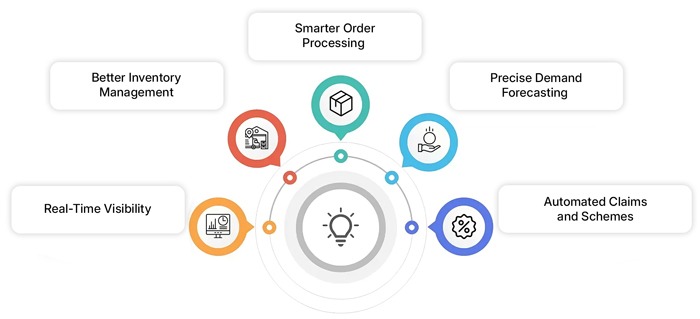
1. Real-Time Visibility With a DMS, brands are able to monitor sales, stock, and order status in real-time with a DMS. As an example, a cosmetics company can track the flow of inventory in all distributors in real-time. Thus, it is able to react to the changes in demand in a timely manner.
2. Better Inventory Management Overstocking is a waste of money. Understocking loses sales. A DMS can bring out the right balance. It utilizes data to demonstrate the demand trends and inventory at each chain point. As a result, brands will be able to forecast restocking better.
3. Smarter Order Processing Manual order taking creates errors and time wastage. A DMS automates booking of orders and minimizes errors and accelerates fulfilment. As an example, a pharmaceutical distributor may speed up the order and have medicines arrive on time to the pharmacies.
4. Precise Demand Forecasting A DMS involves the use of historical sales records and predictive analytics to predict demand. This assists distributors to avoid stock over brings and minimize stockouts. Moreover, it assists in trade promotions planning.
5. Automated Claims and Schemes It is sloppy to handle promotional schemes and settlements of claims manually. This is automated by a DMS. Both distributors and brands can monitor their claims in real-time and settle them faster. This creates loyalty and trust throughout the network.
Key Features of a Distributor Consumer Management System
Let us look at the core features that make a DMS powerful:
1. Inventory Management A DMS provides real-time access to stock quantities within the full distribution system. It monitors the product movement, expiry dates and batch numbers. Consequently, brands can prevent wastes and maintain freshness particularly in food and pharma segments.
2. GST-Ready Invoicing Invoices that are GST compliant are automatically generated using modern DMS software. It also does e-way bills and e-invoices simultaneously. This will eliminate a massive compliance liability on distributors, as well as expedite the billing process.
3. Order Management The DMS will monitor all the steps starting with order placement to delivery. Distributors are able to make orders via a mobile application or even WhatsApp. Then, the brands will receive immediate order status visibility. This saves time and makes life easier.
4. Promotion and Scheme Management It is essential to carry out the appropriate promotional campaign at the appropriate time. Through a DMS, a brand can establish, administer and monitor schemes in various channels and locations. It also makes sure that promotion is done with correctness and no mistakes are made when doing it.
5. Collections and Credit Control A DMS assists distributors to monitor payments, credit limits and identify overdue accounts. In case a retailer exhausts his or her limit, new orders can be held automatically by the system. This helps to secure the brand against bad debt and enhance the order to cash cycle.
6. Sales Analysis and Reporting Good decisions are made on the basis of data. A DMS offers live dashboards of KPI trends, zone-based demand data, and performance at a territory-level. Hence, sales managers will be able to detect gaps and opportunities quicker.
7. Reverse Logistics and Returns The management of returns is a pain. A DMS allows distributors to record returns with reasons, photographs and approval procedures. The system monitors replacements and credit notes and ensures that the returned stock is quarantined accordingly.
How Does a Distributor Consumer Management System Work?
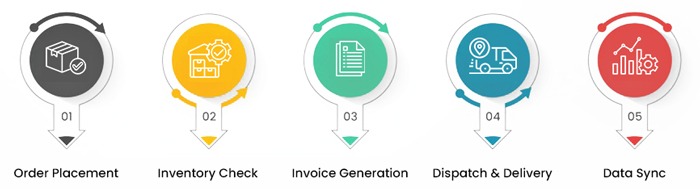
The following is a crude description of how a DMS works in practice:
Step 1: Order Placement: A retailer orders with his distributor. This order is delivered to the distributor immediately via the DMS mobile portal or application.
Step 2: Inventory Check: The DMS verifies the levels of inventory and confirms the availability of products. It also verifies relevant schemes and promotions.
Step 3: Generation of invoices: The system will automatically produce a GST-ready invoice using the appropriate price list and tax regulations.
Step 4: Dispatch and Delivery: The DMS follows dispatch and route optimization. This saves on fuel and enhances speed of delivery.
Step 5: Data Sync: Sales, stock data, and payment data are all updated back with the central system of the brand in real time. Thus, the brand has a precise market activity picture at all times.
Challenges in Implementing a Distributor Consumer Management System
Although these advantages are evident, they are not always implemented overnight. Brands do have certain general pitfalls:
- Resistance to Change: The manual systems are familiar to many distributors, particularly those in smaller towns. It is hard and time-consuming to change their mentality. The trick is to convince them that a DMS will not complicate their work but make it more convenient.
- Lack of Technical ability: Not all the distributors are technologically inclined. The platforms should be easy to use, mobile, and user-friendly without professional training.
- Infrastructure Gaps: In some remote locations, the internet connection is not reliable. Hence, a decent DMS must operate in offline mode too, and synchronize the data when the connection comes back.
- Linking to Existing Systems: A great number of distributors are already equipped with billing solutions such as Tally or Busy. An excellent DMS cannot happen independently of these tools, they need to be built to work together as opposed to substitutes. This will prevent duplication and minimize opposition.
Regardless of these issues, there is an increasing number of distributors adopting DMS software. This is because it is an easy thing to do early on and it creates a real competitive edge.
Who Should Use a Distributor Consumer Management System?
A Distributor Consumer Management System is most useful for:
- FMCG and CPG brands with wide distribution networks
- Food and beverage companies managing multiple SKUs and expiry-sensitive products
- Pharmaceutical distributors who need accurate order fulfilment and compliance
- Personal care and home care brands expanding into new markets
- Electronics distributors managing high-value inventory
In short, if your business has distributors, retailers, and a complex supply chain, a DMS will add significant value.

Conclusion
A Distributor Consumer Management System is one of the most important investments a consumer goods brand can make today. And this is where PepUpSales comes in. PepUpSales is an AI sales force automation and distribution management platform built for FMCG and consumer goods brands. It helps field teams, distributors, and retailers work together seamlessly on one platform.
Whether you are trying to reduce stockouts, improve retailer coverage, or speed up order processing, PepUpSales has the tools to make it happen. The platform is designed to be simple enough for distributors to adopt quickly, and powerful enough to give brand managers the data they need.
Ready to transform your distribution operations? Explore PepUpSales today.


