
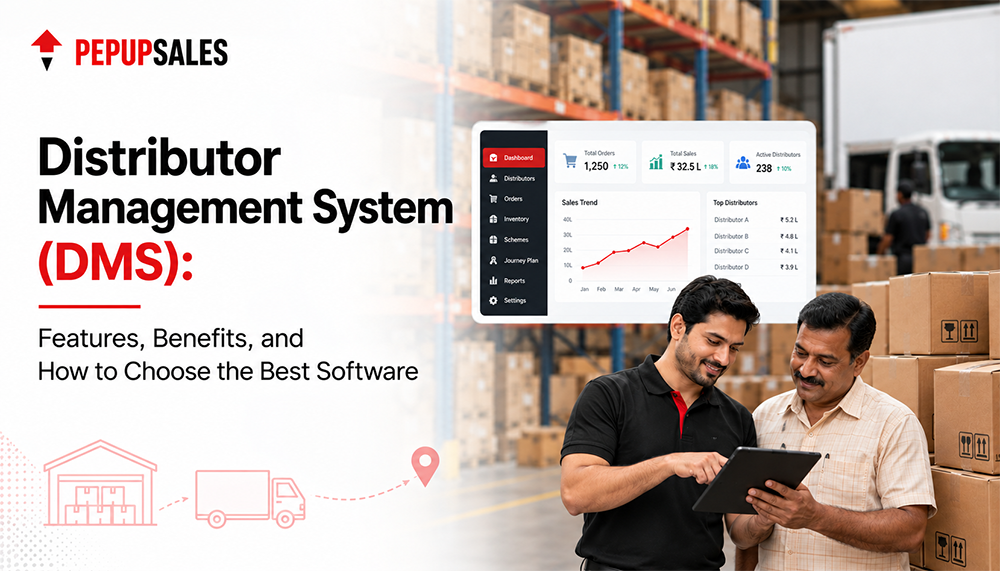
TL;DR: A distributor management system gives brands real-time visibility into orders, inventory, schemes, claims, collections, and secondary sales. This guide explains the essential features, business benefits, industry use cases, and criteria for selecting the right DMS.
Every distribution network exists to solve one basic problem: getting products from a warehouse to a retail shelf across hundreds or thousands of outlets, without losing visibility along the way. In India, this challenge becomes especially complex because brands often serve a fragmented retail market through multiple channel partners, including super-stockists, distributors, sub-distributors, wholesalers, and retailers. As a network expands across cities and territories, keeping orders, inventory, claims, payments, and sales activity aligned becomes far more difficult without a connected system.
This isn’t a theoretical problem; it’s an active one. In mid-2026, the AICPDF publicly warned FMCG companies that the country’s traditional distribution network had reached a breaking point, pointing to rising operational costs and reduced market-servicing frequency as direct causes of retail stock-outs. When India’s own distributor body is flagging stock-outs as a national-level risk, the case for real-time visibility stops being theoretical and starts being urgent.
This is exactly the gap a distributor management system is built to close.
What Is a Distributor Management System and Why it Matters?
A distributor management system (DMS) is software that connects manufacturers, distributors, and retailers on a single platform, managing orders, inventory, claims, payments, and secondary sales in real time.
To see why this matters, picture a business that starts out selling in one city. Tracking orders over phone calls and messages works fine at that scale, since one person can reasonably keep it all in their head. But once that same business starts working with distributors across ten cities, the approach breaks down fast. Stock counts stop matching what’s actually on the shelf. Orders get delayed because nobody can confirm availability in time. Claims and payments pile up faster than anyone can reconcile by hand, and by the time discrepancies surface, weeks of sales data are already gone.
A DMS integrates orders, inventory, payment, claims, and activity on the field into a single connected workflow. Teams can avoid stock mismatches, delayed orders and unpaid claims weeks after they arise rather than discovering them and taking action after it impacts retailer availability or distributor relationships. This transforms the distribution management position into a more regulated and scalable one, as opposed to the spreadsheets and reactive approach.
What Features Should a Distributor Management Solution Have?
Distributor management solutions aren’t created equal. Before comparing vendors, businesses should understand the workflows and operational complexity they need to manage.
For organizations with a complex distributor hierarchy, multiple companies/business units, or high transaction volumes, the DMS should be capable of supporting sophisticated distribution operations without creating additional data silos.
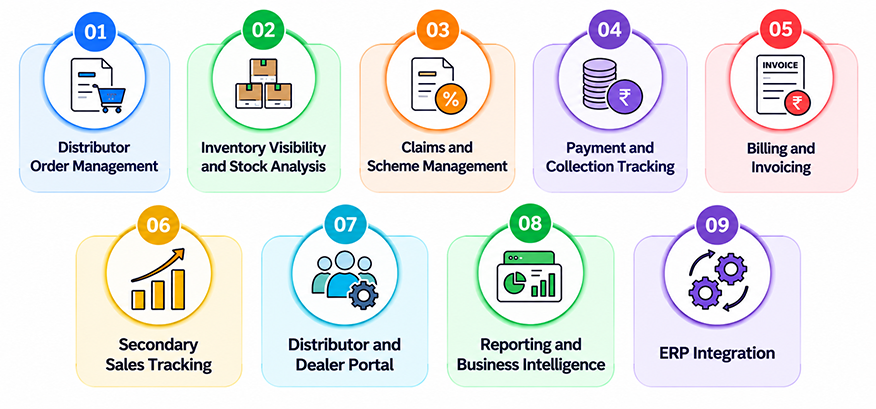
1. Distributor Order Management
Order management is the backbone of any DMS. The system must provide an easy way for a distributor or sales representative to place an order, and manage pricing, discounts, schemes, credit limits and product availability in the background. Look for:
- Digital order booking
- Product and SKU catalogues
- Price-list management
- Check for validation of scheme/discount codes
- Credit-limit checks
- Order approval workflows
- Order status tracking
- Returns and cancellations
- Automated order processing
The goal is simple: to reduce the “friction” between ordering and delivering.
2. Inventory Visibility and Stock Analysis
A distributor might deal with hundreds or thousands of SKUs. Without a connected system, tracking inventory would be prone to upsetting inaccuracies and omissions which only come to light during the reconciliation process. A good DMS will present everything such as opening stock, purchase, sales, returns, transfer etc. and closing stock in a single view.
It should also be compatible with batch/expiry tracking as needed by the industry. Not only is it important to know how much stock is available, it’s important to be able to answer questions such as:
- What are the overstocked distributors?
- Are there areas that are likely to experience stock-outs?
- What are the low velocity SKUs?
- What products need to be restocked?
- What amount of inventory is currently on the move?
This connects distribution information to better replenishment decisions.
3. Claims and Scheme Management
If businesses have trade schemes using spreadsheets and/or disjointed approval processes, it can be challenging to ensure that eligibility and payments are accurately tracked. Eligibility rules, claim capture and structured approval workflows are all in one place and managed by a capable DMS.
This provides more transparency for both brands and distributors. With regard to trade promotions, pricing, order processing, financials, proof of performance, and claims workflows are increasingly being tied together, bringing a need for them to remain accountable.
4. Payment and Collection Tracking
Distribution involves more than moving products. There should also be a record of outstanding payments, credit limits, collections and distributor balances – all of which require monitoring and tracking, and should be accessible to both the finance and sales teams. Here, shared visibility helps to minimize follow-up efforts, and allows teams to concentrate on accounts that actually require their attention.
5. Billing and Invoicing
Billing should seamlessly fit into order and inventory processes. At the point in time that the order is moved to the invoicing stage, the system should share the same product, pricing, tax and customer data automatically.
It is also important for enterprise businesses to verify whether the DMS connects with their financial and ERP systems, because if the DMS is not integrated with these systems, then there will be problems with reconciliation again in the past.
6. Secondary Sales Tracking
One of the most beneficial features of a DMS for a brand with a substantial retail presence is secondary sales tracking. It provides businesses with information on the movement of the product beyond the distributor level, particularly in conjunction with the retailer and field sales data.
For organizations focused on deep primary/secondary sales management, this visibility helps connect distributor-level transactions with actual market movement.
This typically covers:
- Outlet-level sales trends
- Distributor performance
- SKU movement
- Territory performance
- Market coverage gaps
- Retailer productivity
By connecting primary and secondary sales data, businesses can build a clearer picture of product movement across the distribution network.
7. Distributor and Dealer management software
A distributor portal provides channel partners direct access to their information. Depending on the business model, distributors will be able to:
- Place orders
- Check inventory
- View invoices
- Track payments
- Access pricing
- Monitor order status
- Review statements
- Manage claims
The end result is reduced reliance on sales representatives for simple requests.
8. Reporting and Business Intelligence
Reports are not simply “transaction dumps. A powerful DMS platform enables management to see what the data is really telling them via dashboards of sales, stock, orders, collections, distributor productivity, SKU performance, territory performance and scheme effectiveness.
The best platforms integrate operational workflows and dashboards to enable management to translate raw transactional data into actionable ideas for replenishment, pricing, promotions, territory coverage and distributor performance.
9. ERP Integration
As a business grows, integration with other business tools becomes crucial. Your DMS should be able to integrate with other systems such as SAP, Oracle, Tally, Microsoft Dynamics, or a bespoke ERP system, and provide accurate information between them.
This model for integration will depend on your architecture, but the objective remains the same: don’t form a new data silo. In comparing platforms, verify with them which ERP systems they are compatible with, what information is able to be synced between systems, how often data will be updated, and whether the integration will be able to accommodate your future scale.
Benefits of the Best Distributor Management Software
So what does all this translate to on the ground? These are some of the changes businesses can expect to experience after implementing the Best distributor management software.
- Less stock out and over stocking. Teams are able to respond to low inventory levels before they become lost sales, rather than waiting to find out about the shortage after a retailer is already out of stock.
- Faster order-to-delivery cycles. Satisfaction of the distributors typically increases significantly with such delay between placement and fulfillment.
- Better decision-making. Sales leaders can use actual sales figures, rather than estimates, when it comes to pricing, promotions and territory planning, making things a lot more accurate.
- Stronger distributor relationships. Open books and automated claims minimize disputes. With money, distributors have faith in a system rather than a phone call.
- Lower operational costs. Reconciliation, duplicate follow-up calls and paper disconnects all waste time and resources. With them automated, the team can focus on more value-added activities.
- Scalability without proportional headcount growth. As the number of distributors increases, so do you, not to keep more distributors under control.
Why Businesses Choose PepUpSales for Distribution Management
Most companies rely on different tools to support their distributor business, field sales, retailer interaction, reporting, and ERP operations. This typically results in duplicated efforts, out-of-date updates, and reports that are out of sync with the current situation on the ground.
PepUpSales combines distributor management system, sales force automation software, retailer app, schemes, claims, collections and reporting in one platform. These workflows are based on the same operational information, enabling teams to make decisions based on a more consistent order, inventory, distributor and field execution picture.
Additionally, it connects with business systems like SAP, Sage, Busy, Oracle, Tally, Microsoft Dynamics, and custom ERP environments, enabling organisations to operate with seamless data synchronisation between their current technology.
Some customer success stories illustrate how the value of linking distribution and field execution in a single system can be realized:
- Daewoo India reported an 85% improvement in field-sales execution and 65% faster distributor order processing after using PepUpSales to unify field-sales and distribution operations.
- FDC Pharma reported a 72% increase in sales and profits, 78% faster order processing, and 67% better visibility into distributor payments after integrating PepUpSales with its SAP environment.
The bottom line is that results vary by business, but once distributor operations, field activity and reporting work are based on connected data, teams can be more responsive and control growth with greater ease.
DMS Use Cases by Industry
The core problem a DMS solves, visibility and coordination, shows up differently depending on the industry.
1. FMCG and CPG: High order volumes and fast-moving SKUs make scheme automation and secondary sales tracking essential. At this scale, order suggestions need to reflect actual sales velocity, not just what a distributor ordered last time.
2. Pharmaceuticals: Batch and expiry tracking is not an option, it’s a regulatory requirement. An early warning of the expiration date of the near-expiry stock and clear routing of returns, both through a clear claims process and early warning of expiry date, helps to avoid compliance problems, and unnecessary write-offs.
3. Building materials: Transactions are more expensive and take longer to sell. That leaves pricing accuracy and seamless ERP integration even more crucial for this shoe size than those in more rapidly moving product categories because reconciliation mistakes come at a cost.
4. Beverage and dairy: Little time to wait and little time to go bad. Real-time stock data improves the distributor’s ability to order before there is a shortage of product on the retailers’ shelves.
5. Consumer durables: Schemes that change according to the time of the campaign work well, and are more effective than those that run on a set reorder cycle that fail to respond to peaks in demand.
6. Automotive and spare parts: Fulfillment accuracy is much more important here, as part-level tracking and warranty claims are much more valued and can make the difference between having a job done in a timely fashion or not at a workshop or reseller.
The same is true of these industries: brands that leverage their distributor network as a living source for demand data reap greater benefit from a DMS than those that simply record transactions.
Final Thoughts
The best distributor management system isn’t necessarily the platform with the longest feature list. It is the platform that fits your distribution model, integrates your current system, wins the distributor’s approval and provides management with accurate information to make informed decisions.
Simple order and inventory management might suffice for smaller networks. For larger businesses, it’s more than just a requirement: integrated workflows, secondary sales visibility, ERP integration, analytics, scalability and good channel collaboration.
For a complex sales and distribution environment, PepUpSales integrates DMS, SFA, retail execution, analytics and channel collaboration all into one platform. Get a free demo to find out how it works with your distribution model and business needs.

Frequently Asked Questions
1. What does distributor management software actually do?
It gives a brand and its distributors a shared system for managing orders, inventory, schemes, claims, and both primary and secondary sales. Field reps record orders from mobile, distributors log their inventory, and the brand gets performance across the channels without a single periodic report.
2. Can a DMS help manage returns and claims?
Yes. With a well-designed workflow and digital proof, a competent DMS takes care of claims for damages, expiry or against the scheme of operation. This is one of the most frequent conflicts between brands and distributors, and is a definite benefit to a good system.
3. Can distributor management software manage schemes and discounts?
Yes. A DMS can assist a company to establish and administer distributor programs, discounts, incentives and promotions. It can use eligibility rules for transactions and make claims run using structured approvals, making complex schemes a lot more consistent to run.
4. Can a distributor management system integrate with ERP software?
Yes. ERP can be integrated with Enterprise DMS Platforms such as SAP, Oracle, Tally and Microsoft Dynamics. The integration usually includes synchronizing product masters, customer data, orders, invoices, stock and financial transactions, but the extent of synchronization depends on the DMS and ERP system being integrated.
5. What is the price of distributor management software?
There are multiple factors that affect DMS pricing such as: number of users, number of distributors, required modules, transaction volume, integrations, customization, implementation, and support needs. The total cost of ownership and platform value should be considered, rather than just the cost of the subscription.
6. How do I schedule a free demo of distributor management software?
You can request a free PepUpSales demo to learn more about the platform and how it aligns with your distribution network. The demo shines a light on the features of DMS, distributor workflows, integrations and reporting, and assists you in determining whether the platform is the right fit before making a purchasing decision.


