
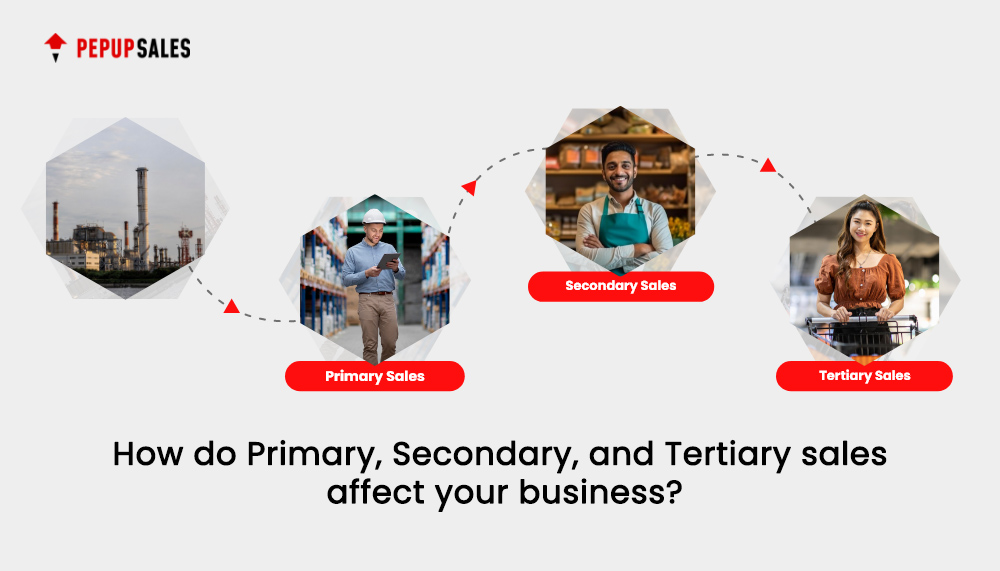
Every product follows a path before it reaches a customer’s hands. That path has three stages: primary sales, secondary sales, and tertiary sales. Primary sales happen between a company and its distributors. Secondary sales happen when distributors sell to retailers. Tertiary sales happen when retailers sell to the end consumer. Together, these three stages decide how smoothly your products move, and how much revenue your business actually earns.
Sales isn’t just one transaction. It’s a chain of transactions, and each link in that chain affects the next. A delay or a gap at any stage can disrupt the entire supply chain. That’s why understanding primary, secondary, and tertiary sales matters so much for any brand that wants steady growth.
In this blog, we’ll break down what each type of sales means. We’ll also look at how they affect your business, and how you can improve all three.
What are the types of sales in business?
Sales are further divided into three categories: primary sales, secondary sales, and tertiary sales. Even after the product is manufactured, the journey isn’t over yet. it is very crucial at this stage to bridge the gap between the product and the customer’s needs.
It is a very crucial phase of a business and important to understand what are the different kinds of sales, how they work, and how they are responsible for the success of a brand. All three sales types Primary, Secondary, and Tertiary Sales are necessary to fill the gap between company and customer’s needs.
What is Primary Sales?
Primary sales is the transaction between a company and its distributors. When a distributor places an order and receives stock from the manufacturer, that’s primary sales. The company raises an invoice, and the value of that invoice becomes the company’s primary sales revenue.
This number looks good on paper, but it doesn’t tell you the full story. High primary sales numbers can sometimes hide a problem, since distributors might be sitting on unsold stock. That’s why smart brands don’t stop tracking after primary sales. They also look closely at secondary and tertiary sales.
Several factors influence primary sales, including brand reputation, market demand, and how well a company manages its distributor relationships. A strong primary sales process sets the foundation for everything that follows in the supply chain.
What is Secondary Sales?
Secondary sales is the step that comes after primary sales when the distributor purchases the product from a company and sells it to the retailers. Now, the distributor will act as a dealer in the market, ready to sell the products. In the whole process, the distributor sets the price limit and gets its margin and profit on the product.
The selling of a product depends on the demand for the product and the popularity of the brand. Secondary sales are more important for a manufacturer than primary sales because if secondary sales are not happening then it will affect the primary sales as well.
For example, huge FMCG brands are selling their products. The market gap is huge and customers are more likely to buy those products because of trust and value as compared to other small companies, who are making their way up in the market. That is where the data on competitor analysis is needed. SFA gives you the analysis of competitor’s performance and provides a better solution to sell your product in the market.
What is Tertiary Sales?
Tertiary sales is the last stage of the whole sales process and it involves the transaction between retailers and customers. After buying the product from a distributor, the retailer is all set to sell the product in the market. However, certain conditions affect the sales:
- Tertiary sales are unpredictable and rely on a lot of factors in the market like popularity, necessity, demand, brand value, advertising, marketing campaigns, discounts, and many more.
- Good sales require the authenticity and ingenuity of the product for the customers.
- Tertiary sales are sold at either MRP(Maximum Retail Price) or MOP (Market Operating Price).
Primary vs Secondary vs Tertiary Sales: What’s the Difference?
The easiest way to understand the difference is to look at who’s involved in each transaction.
- Primary sales: the company sells to the distributor
- Secondary sales: the distributor sells to the retailer
- Tertiary sales: the retailer sells to the consumer
Each stage generates its own revenue number, but only tertiary sales shows you the true demand for your product. Primary sales can stay strong even when tertiary sales are weak, at least for a while. That gap always catches up eventually though, usually in the form of unsold stock and unhappy distributors who stop placing fresh orders.
This is also why comparing all three numbers side by side matters. It gives a far more honest picture of business health than looking at primary sales alone.
Take a simple example. A beverage brand ships stock worth ten lakh rupees to a distributor in a month. That’s the primary sales figure. The distributor then sells eight lakh rupees worth of stock to local retailers, which becomes the secondary sales number. By month-end, retailers manage to sell only six lakh rupees worth to actual customers. That gap between ten, eight, and six lakh rupees tells you exactly where the slowdown is happening, and where you need to step in.
How can you increase Primary, Secondary, and Tertiary sales?
Sales are the most important part of the whole business, good sales performance decides the profit and future of a company. There are several reasons why you should do sales optimization to grow your business and get good sales. Brands need to have a strategy ready to beat the adherence and market needs. A good market share leads to better customer satisfaction and product visibility. This section is solely discussed to optimize Primary, Secondary, and tertiary sales.
Primary sales optimization with distributors
- Improvement in primary sales needs a strong relationship between the company and the distributor, which leads to trust and integrity in the market.
- Regular checks on the inventory ensure that the stocks never run out. This guarantees the distributor that the direct source of income from the brand remains unaffected.
- Pepupsales SFA gives the best collaborative UI to outperform competitors through product availability and efficient distribution.
Secondary sales optimization with retailers
- It involves a strong connection between distributors and retailers, creating a steady distribution of products. Stocked inventory means the retailers are already prepared to meet consumer demands.
- Well-optimized secondary sales directly impact the growing business, leading to fewer stock complaints, more trust, and integrity with the brand incorporation of loyalty points and special schemes.
- Secondary sales can be optimized by providing access to the sales data of retailers, leading to better analysis and driving countermeasures for better performance.
Tertiary sales optimization with customers
- Optimization of tertiary sales entirely focuses on the sales with end customers. This includes a healthy relationship between a retailer and a consumer.
- The tertiary sales process can be optimized with the data collected from the sales reps through SFA to ensure that the product meets the needs of a customer.
- Analysis of tertiary sales with SFA can help get feedback from potential customers. Positive customer experience leads to more demand for the product in the market.
Conclusion:
It should be kept in mind, that every sales process demands better performance, integrity, and collaborative sales efforts. Primary, Secondary, and tertiary sales are interlinked and dependent on each other to meet the end customer requirements. Better supply creates demand in the market and also leads to many benefits like product visibility, brand recognition, loyalty, and many more.
Pepupsales SFA offers a platform that allows the brands to stay on top of the market with better supply chain and sales performance. With the modules included in pepupsales SFA gives a better UI environment that ensures everyone is in the loop about what’s happening in the market. It comprises customizable UI, easy communication, smart KPIs and so much more. We don’t recommend trusting blindly. Try the free demo provided and clear all the doubts related to sales and operations.
Frequently Asked Questions
1. What is the difference between primary and secondary sales?
Primary sales is the transaction between a company and its distributor. Secondary sales is the transaction between a distributor and a retailer. Primary sales tells you what distributors ordered, while secondary sales tells you what retailers actually picked up and stocked.
2. Why are secondary sales more important than primary sales?
Secondary sales reflect what’s actually moving in the market. High primary sales with low secondary sales usually means unsold stock is piling up with distributors. This eventually slows down future orders and hurts long-term growth.
3. How can a business track tertiary sales?
Most businesses track tertiary sales using field sales apps. These apps collect data directly from retail outlets, including stock levels, order frequency, and point-of-sale information gathered by sales reps on the ground.
4. What tools help manage primary, secondary, and tertiary sales together?
Sales force automation platforms are commonly used to track all three sales stages in one place. This helps businesses spot gaps early and act on them before they affect revenue.
5. Is it possible to have good primary sales but poor tertiary sales?
Yes, this happens often when distributors keep ordering stock that isn’t actually selling at the retail level. It usually points to a demand mismatch that needs urgent attention.
6. Can I get a free demo of PepUpSales software?
Yes, of course. You can book a free demo, and our team will show you how PepUpSales works for your sales process, team structure, and business goals in real time.


